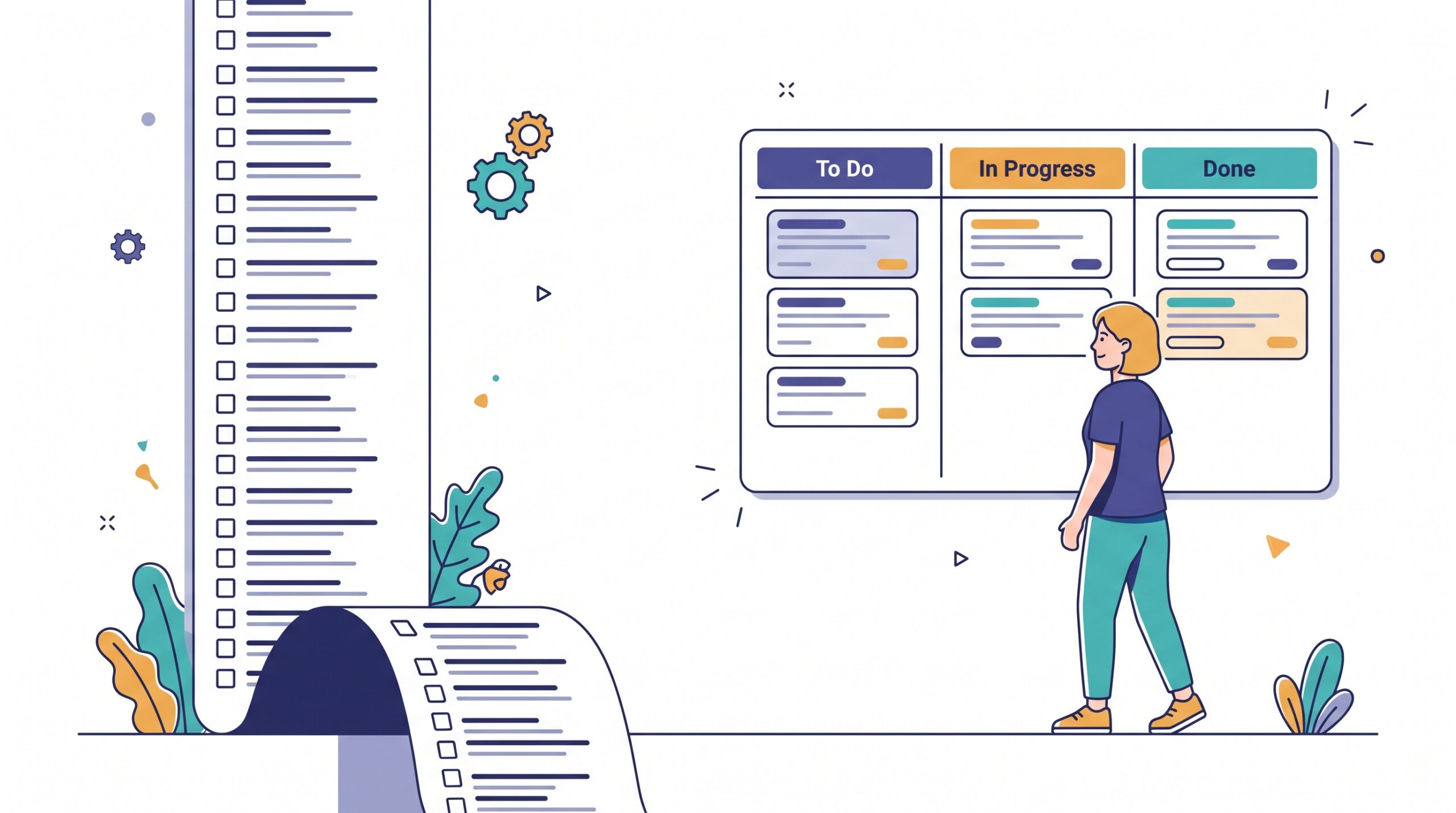
Be honest: how long is your to-do list right now? If you’re like most busy owners and freelancers, the answer is somewhere between “too long to read” and “I stopped looking.” You started it with the best intentions — one tidy place for everything you need to do — and for a while it felt great. Then it grew. And grew. New items landed faster than you could cross old ones off, the important things got buried under the trivial ones, and that satisfying little checkbox stopped feeling like progress and started feeling like a quiet accusation. The problem isn’t your discipline. It’s the tool. A to-do list is built to collect work, and it’s genuinely good at that — but it has no idea how to help you actually finish it. That’s the gap a kanban board fills.
Why a to-do list feels productive but often isn’t
A list gives you a tiny hit of satisfaction every time you add something to it. You capture a thought, you feel organized, and your brain rewards you — even though nothing has actually been done. That’s the first trap: a list conflates writing work down with making progress on it. The two feel similar and are completely different.
The second trap is that a flat list treats every item as equal. “Reply to Dave” sits in the same plain row as “Launch the new product line,” so your eye naturally grabs the quick, easy ones to enjoy the checkmarks. The big, important, uncomfortable work stays near the bottom, un-started, week after week. A list doesn’t lie to you exactly — it just has no way of showing you the difference between busy and effective.
A list hides your workload; a board shows it
Here’s the deepest difference. A to-do list only ever shows you one thing: what hasn’t been crossed off yet. It can’t show you what’s in progress, what’s stuck waiting on someone else, or what’s nearly done. Everything that isn’t finished looks identical — a flat wall of un-ticked boxes.
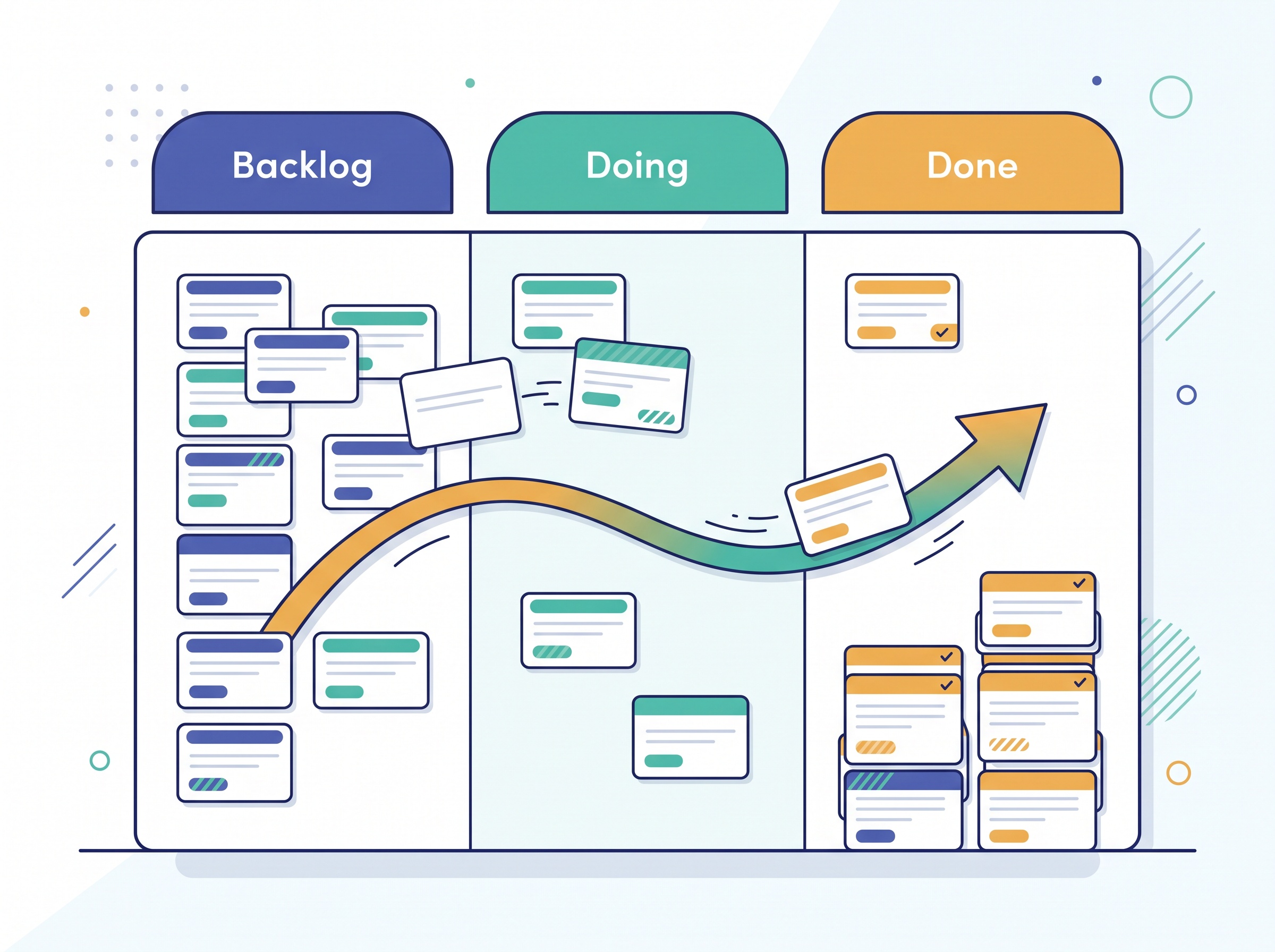
A kanban board replaces that flat list with a few simple columns — typically a backlog (“to do”), a “doing” column, and a “done” column — and lets each task become a card you physically move across them. Suddenly the invisible becomes visible. You can see at a glance that four things are in progress, two are blocked, and one’s about to ship. The work stops being a bottomless list and becomes a picture of your actual state. If you’ve ever tried to run everything out of your email, you already know this feeling — it’s the same relief people describe when they turn a chaotic inbox into a board instead of a scrolling list of unread guilt.

The ingredient your list is missing: limiting work in progress
This is the part a to-do list literally cannot do, and it’s the single biggest reason boards win. A list has no ceiling — you can pile on a hundred items and it’ll cheerfully hold them all. A board lets you set a work-in-progress limit: a cap on how many cards are allowed in the “doing” column at once.
It sounds like a small rule, but it changes everything. When your “doing” column can only hold, say, three cards, you’re forced to finish something before you’re allowed to start the next thing. No more juggling eleven half-done tasks and completing none of them. The list encourages you to start everything; the board gently insists that you finish. That shift — from starting work to finishing work — is where the real productivity gain lives, and it’s the same discipline that cuts down the hidden drain of constant context-switching that leaves you feeling busy but shipping little.

From a flat list to real flow
A to-do list is static. You write it, you stare at it, you cross a couple of things off, and the rest just sits there looking the same tomorrow. A board, by contrast, is built around movement. Work flows into the backlog, gets pulled into “doing” when there’s capacity, and moves into “done” when it’s truly finished.
That flow gives you two things a list never will. First, momentum you can actually see — watching cards march into the done column is far more motivating than deleting a line of text. Second, a built-in early-warning system: when a card sits in “doing” for days without moving, the board makes the problem impossible to ignore, instead of letting it hide in the middle of a long list. You stop wondering “why do I feel behind?” and start seeing exactly where things are getting stuck.
You don’t have to abandon your list overnight
The good news: switching to a board isn’t a dramatic break. Your existing to-do list is actually the perfect starting material — it’s your backlog, already written. The migration is simple: make three columns, turn each list item into a card, drop them all into the backlog, and then pull only a few into “doing” to begin. That’s it. You’ve just upgraded a flat list into a working system in about ten minutes.
If your “list” is really a wall of paper notes or scattered scraps, the move is just as natural — we walked through exactly that transition in going from sticky notes to a kanban board. The one habit worth adopting from day one is to be thoughtful about what you actually put on each card, so a card carries enough context to be worked on — not just a three-word reminder like your old list entries.

When a to-do list is still the right tool
To be fair, the humble list isn’t worthless — it’s just being asked to do a job it was never designed for. For a quick, same-day set of errands (“milk, bank, call the plumber”), a plain checklist is perfect: low stakes, short-lived, done by dinner. A list also makes a fine capture tool — a scratchpad where thoughts land before you sort them onto your board. The distinction is simple. Use a list for small, finite, throwaway batches. Reach for a board the moment work becomes ongoing, shared, or genuinely important — anything with more than a handful of moving parts, anything involving other people, anything you can’t afford to let quietly stall.
And if you’re wondering whether you need something heavier than kanban, like a full sprint-based process, that’s a fair question too — we compared the options honestly in kanban vs. scrum. For most small teams and solo operators, though, the sweet spot is a simple board: more structure than a list, far less ceremony than scrum.
The takeaway
A to-do list is a great place for work to land and a terrible place for it to live. It collects, but it doesn’t limit, flow, or finish — so it grows without end and quietly stops being something you trust. A board takes the exact same work and gives it columns to move through, a cap to keep you focused, and a visible path to done. So if your list has become a scroll of guilt you’ve stopped opening, don’t try harder at the list. Pour it into a simple kanban board, cap what you let yourself start, and watch the thing that always felt endless finally start to move.