It’s Monday morning. You glance at the board, it’s full of cards, everyone knows what to do, and you feel good about the week. Then it slowly dawns on you: Priya’s on vacation until Thursday, Tom only works Tuesdays and Wednesdays, and Sam took a half-day for a dentist appointment. Suddenly that confident-looking board is planning a five-person week for a team that, this week, is really more like two and a half people. The board didn’t lie to you — it just has no idea who’s actually here. That blind spot is where most broken promises and quietly overloaded weeks come from, and closing it is what capacity planning is really about.

Your board silently assumes everyone’s always here
A kanban board is brilliant at showing you what the work is and where it’s stuck. What it doesn’t show, unless you make it, is who’s available to do it. By default a board quietly assumes a full team at full availability, every single week. Real life never cooperates: people take vacations, work part-time, get sick, sit in all-day training, or lose half a day to something unavoidable.
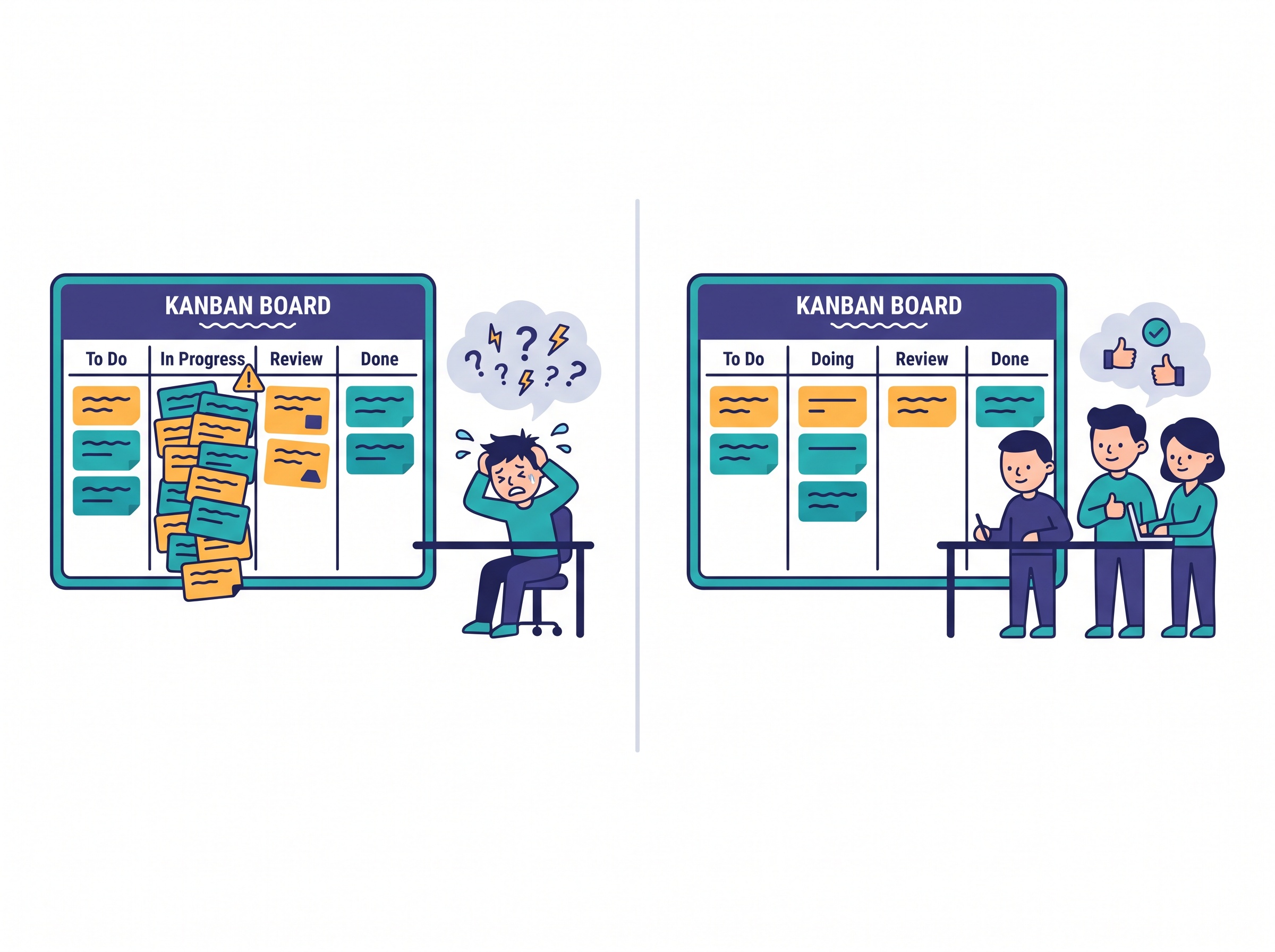
When the plan assumes more hands than you actually have, the result is predictable. Cards pile up in “Doing,” a couple of people quietly absorb the slack and burn out, and commitments you made in good faith start slipping — not because anyone slacked off, but because the maths never worked. Capacity planning just means teaching the board the one thing it can’t see on its own: how many people are genuinely available to pull work this week.
Step one: make availability visible
You can’t plan around something you can’t see, so the first move is to get availability onto the board itself rather than leaving it in your head or buried in a shared calendar nobody opens. It doesn’t need to be fancy. A simple availability strip across the top — a little row of names with a marker for “in,” “out,” or “part-week” — turns an invisible guess into a shared fact everyone can see at a glance.
If your tool supports avatars on cards, lean on them: when every active card shows a face, a short-staffed week becomes obvious the moment you look, because you can literally see three cards all pinned to the one person who’s drowning. The goal isn’t a precise hours-tracking spreadsheet — it’s a rough, honest, at-a-glance answer to “who can we count on this week?”

Right-size your limits to who’s actually here
Once availability is visible, the real lever is this: when you have fewer people, you should have fewer cards in progress. If you use work-in-progress limits — a cap on how many cards can sit in “Doing” at once — then a short-staffed week is exactly when you lower them. A team of five that normally runs a WIP limit of five might drop to three for a week when two people are out. It feels like doing less, but it’s the opposite: it’s refusing to start more work than you can actually finish, which is the whole point of a healthy board.
If you don’t use formal WIP limits, the same instinct applies informally — just pull fewer new cards into the active lanes until people are back. The mistake almost everyone makes is keeping the board as full as ever and hoping the remaining people will somehow move faster. They won’t. They’ll just end up with a dozen half-finished cards and nothing truly done.
Plan around the gaps you already know about
Some capacity hits are a surprise, but most aren’t. Vacations get booked weeks ahead. Part-time schedules are fixed. The standing Thursday-afternoon meeting that eats everyone’s focus happens every Thursday. Those known gaps are the easy wins, because you can plan around them before they bite.
When you decide what to pull into the week, factor in who’s actually around to carry it to the finish line. Don’t start a big card on Monday that only Priya can do when Priya’s out until Thursday — it’ll just sit half-done, blocking the lane. This is really a sharper version of deciding what to work on next: the right next card isn’t only the most important one, it’s the most important one that the people present this week can actually finish. And if one person is a single point of failure for a whole category of work, a thin week is your cue to spread that knowledge — the same reason it pays to stop being the bottleneck and delegate before a vacation turns into a stalled project.
Run a five-minute capacity check every Monday
All of this works best as a tiny recurring habit rather than a heroic one-off. At the start of each week — ideally right at your first standup — spend five minutes on two questions: who’s available this week, and what’s realistic given that? Update the availability strip, adjust your limits up or down, and push anything the week clearly can’t absorb back to the backlog where it waits honestly instead of pretending to be in progress.
That short ritual does something quietly powerful: it keeps the promises you make trustworthy. If you tell a client or a colleague their work will be done Friday, that promise should already account for the fact that half the team is out Wednesday. A board that reflects real capacity is what lets you answer “when will it be done?” with a date you can actually stand behind, instead of an optimistic guess that assumes a full house that isn’t there.

When capacity drops out of nowhere
And then there are the weeks that fall apart on their own — someone’s out sick, a family emergency, a crisis that swallows two people for two days. The instinct is to soldier on with the same plan and quietly hope. Resist it. The move is the same as a planned gap, just faster: look at the board, accept that this week’s capacity just shrank, and take work off the active lanes rather than pretending it all still fits.
Protect the genuinely time-critical commitments first, let the flexible stuff slide back to the backlog without guilt, and — this is the hard part — say so out loud. A board that honestly shows “we’re down two people, so these three things move and everything else holds” is infinitely better than a full board full of promises nobody can keep. Capacity planning isn’t about squeezing more out of people; it’s the discipline of matching what you take on to who you’ve actually got. Learning to protect that capacity, and to say a graceful no when a week is already full, is a skill worth building — we dug into it in the cost of saying yes.
So before you fill next week’s board, ask the question the board can’t ask itself: who’s actually here? Put the answer where everyone can see it, size the work to fit, and check it again every Monday. Do that, and a simple kanban board stops being a wish list and becomes something far more useful — an honest picture of what this particular team, in this particular week, can truly get done.