You know the feeling. Your kanban board is tidy, the cards are clear, the priorities are obvious — and you still can’t seem to start. The card at the top of your This Week column has been staring at you since Tuesday. The board did its job perfectly; it told you exactly what to do next. It just can’t make you do it.
That’s the gap the Pomodoro Technique quietly fills. A kanban board answers the question “what should I work on?” A Pomodoro timer answers a different one: “how do I actually get moving and stay there?” Put the two together and you get a surprisingly powerful little engine — the board decides, the timer delivers. Here’s how to pair them without turning your day into a stopwatch obsession.

Two simple systems that fix different halves of the problem
Kanban is about flow: visualize the work, limit how much is in progress, and move cards left to right until they’re done. The Pomodoro Technique is about attention: pick one thing, set a timer for a focused stretch (the classic is 25 minutes), work only on that until it rings, then take a short break. Repeat.
Neither is complicated, and that’s the point. Their weaknesses are opposite, too. A board can show you a perfect plan you never execute. A timer can give you great focus aimed at the wrong task. Bolt them together and each covers for the other: the board keeps your sprints pointed at what matters, and the sprints keep your cards from gathering dust.
The core move: one card, one timer
The whole method fits in a sentence. Pull a single card from your board, start the timer, and do nothing else until it rings.
If that sounds familiar, it should — a focus sprint is really just a work-in-progress limit of one, enforced by a clock instead of willpower. For the next 25 minutes, that one card is your entire board. No glancing at email, no “quick” look at another card, no reshuffling the backlog. This also reinforces a habit good kanban already teaches: pull work when you’re ready for it rather than letting a dozen things get pushed onto you at once.
The reason it works is almost physical. Starting is the hard part, and “work on this card all afternoon” is a daunting ask. “Work on this card for 25 minutes” is not. You can always do 25 minutes. And once you’re in motion, momentum usually carries you well past the ring.
How to run a Pomodoro-kanban day
A full day on this system has a simple, repeating shape:
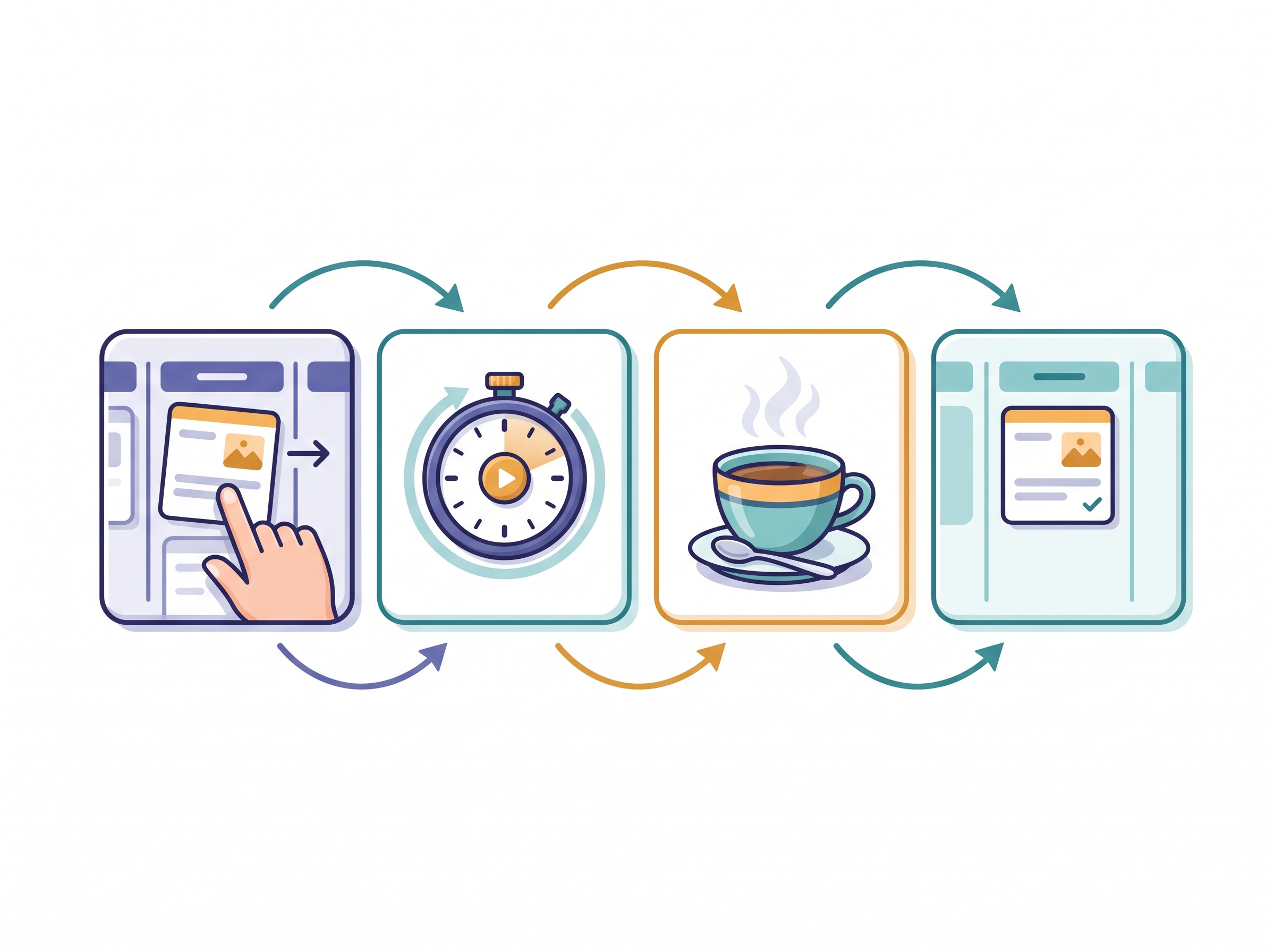
- Pick your card. Look at your board and choose the single most important card you can make progress on right now. If it’s big, that’s a hint to split it (more on that below).
- Move it and start the clock. Drag the card into In Progress so the board shows what you’re actually doing, then set the timer for one sprint.
- Work the sprint. One card, no switching, until the timer rings.
- Take the short break. Three to five minutes — stand up, look away from the screen, breathe.
- Repeat, and after about four sprints, take a longer break of 15 to 30 minutes.
When a card is finished, move it to Done and feel the small satisfaction of it — then pull the next one. Some people jot a tiny tally on each card for how many sprints it took. That number turns out to be quietly useful, as we’ll see.
Let the timer teach you how big a card really is
Here’s a happy side effect. When you start timing your work in 25-minute units, you quickly discover which cards are honestly sized and which are secretly whole projects wearing a single card’s clothing. A card that eats six sprints and still isn’t done was never one task.
That’s exactly the signal to break it up. Smaller cards flow better, finish faster, and give you more of those momentum-building wins — a point we make often, because small cards move faster. The timer just makes the oversizing impossible to ignore. Over a few weeks, the sprint tallies on your cards also become a rough, honest read on how long your real work actually takes — the kind of cycle-time insight bigger teams chase with spreadsheets, earned here for free.
Handling interruptions without losing the thread
The obvious objection: “My day isn’t 25 uninterrupted minutes. People need things.” True. The Pomodoro method has a deceptively good answer — when something pops into your head or someone pings you mid-sprint, you don’t act on it and you don’t ignore it. You capture it and keep going.

In kanban terms, that means dropping a quick card into an intake or Parking Lot column and getting right back to the sprint. The interruption is now safely on the board instead of rattling around your head or derailing your focus. You’ll deal with it on purpose later, not reflexively now. For the genuinely can’t-wait emergencies you still want a clear plan, but you’ll be amazed how few things actually qualify once you make yourself write them down first.
This single habit is the biggest cure for the busy-but-shipping-nothing trap. Constantly answering every ping is just context-switching with a friendly face, and it quietly wrecks your output. A sprint is a small, defensible wall around your attention.
Make the breaks real (don’t skip them)
The part everyone wants to cut is the part that makes it sustainable. The break isn’t slack; it’s what lets you do another focused sprint after this one without frying your concentration by 2 p.m. Skip breaks and you’ll get two good sprints and a mushy afternoon.

So make the break a real one. Step away from the board, don’t just switch to another screen. Walk to the kitchen, look out a window, stretch. The work will still be there, neatly waiting in In Progress, which is one more reason the board matters — you can rest without any fear of forgetting where you were. This rhythm of real effort and real recovery is what keeps the whole system humming, rather than grinding flat-out until you crash by mid-afternoon.
Start with one sprint tomorrow
You don’t need a new app or a perfect system to try this. Tomorrow morning, look at your board, pick the one card you’ve been avoiding, set a timer for 25 minutes, and work on nothing else until it rings. That’s the entire experiment. Most people are surprised twice: first that they started at all, and second by how much a single honest sprint moved a card that had been stuck for days.
A kanban board already gives you the clearest possible answer to “what’s next.” Pairing it with short, protected focus sprints is how that answer finally turns into finished cards. Keep the board simple, keep the sprints honest, and let the two do what neither can do alone.