You know the moment. A client asks, “How long will this take?” and before you’ve really thought it through, you hear yourself say, “Oh, I can have that by Friday.” Friday arrives. The work is three-quarters done, two surprises showed up, and now you’re sending the awkward “just need another day or two” message.
Missed deadlines rarely come from laziness. They come from hopeful guessing. We picture the smooth version of the job in our heads and quote that, forgetting the revisions, the waiting-on-other-people, and the small fires that eat every real workday. The good news: estimating well is a skill, not a talent, and you don’t need spreadsheets or formulas to get dramatically better at it. Here’s a simple system any busy owner, freelancer, or team lead can use to estimate task time and promise dates you can actually keep.

Why your gut is a terrible stopwatch
There’s a well-documented quirk of human brains called the planning fallacy: we consistently expect things to take less time than they do, even when we’ve done the same thing many times before. Your brain remembers the idea of the task, not the messy reality of the last ten times you did it.
Think about a seemingly small job — say, “update the pricing page on a client’s website.” In your head that’s an hour. In reality it’s: find the current copy, confirm the new numbers, make the edits, realize one plan name changed, email the client to check, wait four hours for a reply, fix it, test on mobile, and push live. The “one hour” was really half a day spread across two days. The fix isn’t to think harder. It’s to stop relying on the gut entirely and use a few simple habits instead.
Break the work into pieces you can see
The single biggest estimating upgrade is this: never estimate a big, fuzzy task as one lump. Big tasks hide their true size. Break the job into chunks small enough that each one is obvious — ideally nothing longer than half a day.
“Launch the fall newsletter” is a lump. Broken down it becomes: draft the copy (2 hours), choose and edit images (1 hour), build it in the email tool (1 hour), test send and fix formatting (45 minutes), schedule and write the social post (30 minutes). Suddenly you’re not guessing at a vague cloud — you’re adding up five things you understand. The total will almost always be larger than your original lump guess, and that’s exactly the point.

A nice side effect: once the work is in visible pieces, you can start them, hand them off, or spot the one step that’s secretly the hard part before it ambushes you.
Estimate in ranges, not single numbers
A single number pretends you have certainty you don’t. Instead, give every chunk a quick three-point estimate: the best case (everything goes smoothly), the likely case, and the worst case (something goes sideways). You don’t need math — just three honest gut-feels.
For that newsletter draft: best case 1 hour, likely 2 hours, worst case 4 hours if the client wants a rewrite. When you report up or quote a client, lean toward the likely-to-worst end, not the best. “I’ll have a draft to you Wednesday, final by Friday” protects you far better than “done Tuesday.” You’ll be early sometimes, and being early is a reputation you want.
Let your own history do the forecasting
Here’s the secret weapon almost nobody uses: your past. You have done work like this before, and the actual times are the best predictor you’ll ever find — better than any expert rule of thumb.
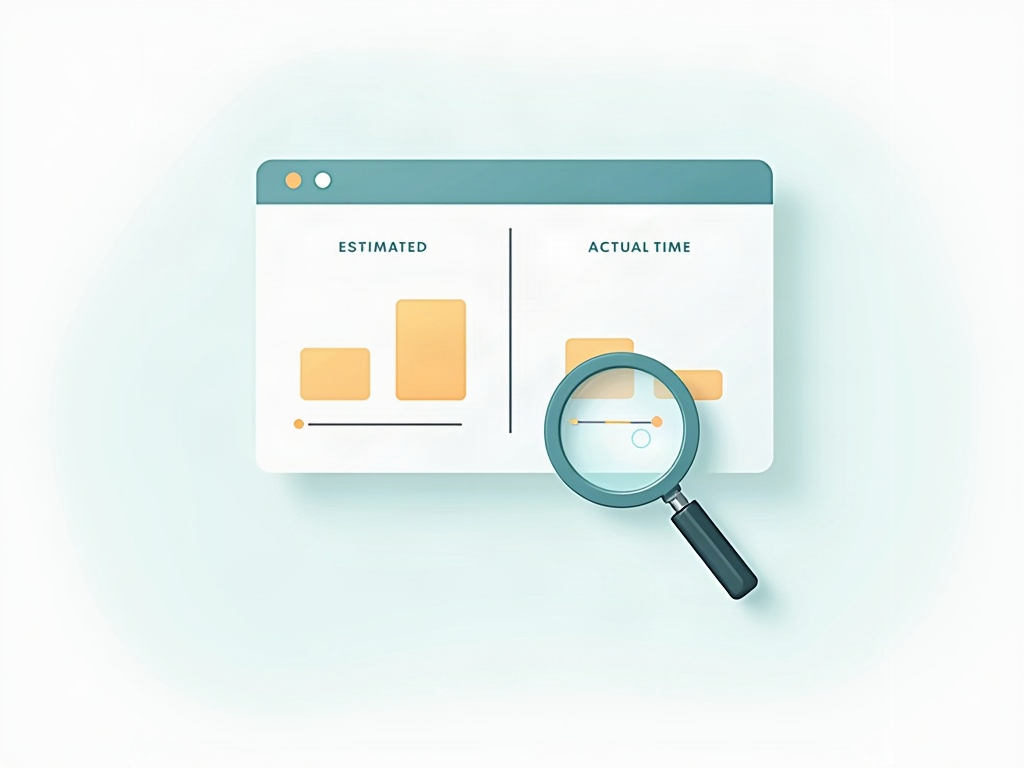
Start keeping a dead-simple log. Each time you finish a recurring type of work, jot down what you guessed and what it actually took. After a handful of entries a pattern appears: “client logo projects always run about 1.5x my first guess,” or “blog posts are reliably three hours, not the two I keep hoping for.” Now you can apply a personal multiplier. If your estimates tend to run 40% short, add 40% and move on. This one habit turns a wishful guesser into someone whose dates people trust.
Budget for the invisible work
Every estimate should include the work you forget to count, because it’s the stuff that actually blows up timelines:
- Reviews and approvals. If someone else has to sign off, that’s not instant — it’s often a day or more of waiting.
- Handoffs. Every time work passes between people, add time for the context to transfer and for things to sit in a queue.
- Revisions. First drafts are rarely final. Build in at least one round of changes.
- Interruptions. Nobody gets eight uninterrupted hours. A realistic focused workday is more like four to five hours of actual task time.
A useful rule of thumb: whatever your pure “heads-down” estimate is, the calendar version — when it will actually be done — is usually longer, because real days are full of other things. Quote the calendar version.
Commit to a date you can defend — then protect it
Once you’ve sized the pieces, added your multiplier, and padded for the invisible work, you’ll have a number that’s bigger than your first instinct and far closer to the truth. Commit to that one. Then protect it: if a new request lands mid-week, don’t silently absorb it — say what it pushes back. “Happy to add that; it moves the newsletter to Monday. Okay?” An honest trade-off beats a quiet broken promise every time.
And resist the urge to re-cut the estimate just because someone wishes it were smaller. The work takes what it takes. Your job is to describe reality clearly, not to make the calendar say what everyone hopes.
Putting it together in one quick pass
You can run this whole process in about ten minutes before you promise anything:
- Break the job into chunks of half a day or less.
- Give each chunk a best / likely / worst guess.
- Add your personal multiplier from past projects.
- Pad for reviews, handoffs, revisions, and interruptions.
- Quote the calendar date, leaning toward the safe end.
The payoff compounds: fewer scrambles, calmer weeks, and clients and teammates who learn that when you say a date, it happens. That trust is worth far more than the occasional thrill of promising something fast.
If you want the pieces to stay visible instead of living in your head, lay them out as cards on a simple kanban board — one card per chunk, the estimate right on the card, and a quick note of the actual time when it’s done. Over a few weeks you’ll have both a clearer board and a quiet little history that makes your next estimate sharper still.