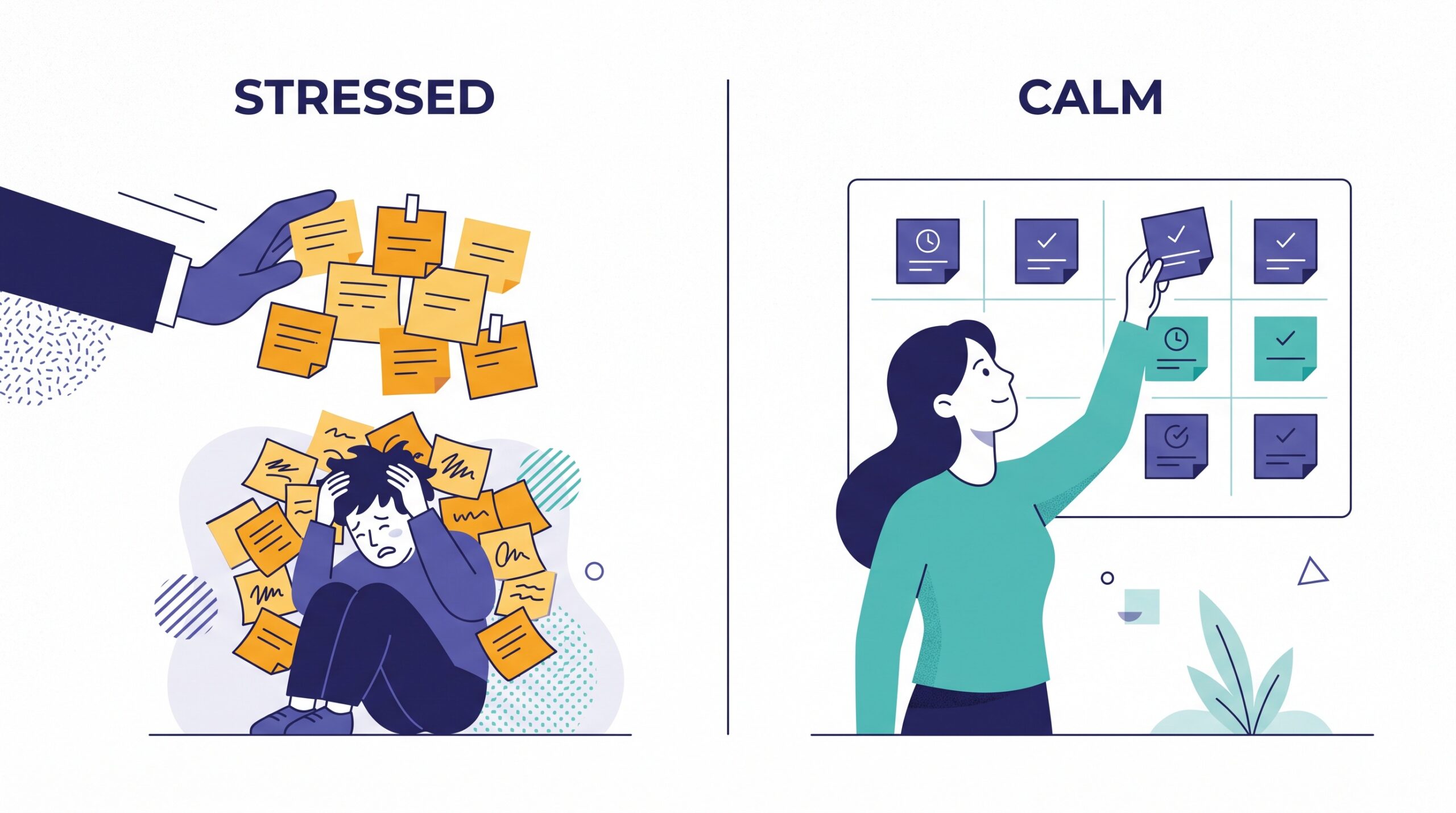
Think about how work usually reaches your team. Something comes in, you decide who should handle it, and you hand it to them: an email, a message, a tap on the shoulder. That is a push system. You are the one pushing tasks onto people, whether or not they have room for them.
There is a quieter, sturdier way to run things, and a kanban board makes it almost automatic. Instead of you pushing work out, your team pulls it in: when someone finishes a card and has capacity, they take the next one themselves. It sounds like a small distinction. In practice it fixes overload, idle time, and about half the questions you field in a day.
What “pull” actually means
In a push system, the amount of work someone has is decided by whoever is handing it out. If three people all send work to the same team member on the same morning, that person now has three things, regardless of what they can realistically finish. The overload is invisible until something slips.
In a pull system, the flow runs the other way. Work waits in a Ready column, ordered by priority. When a team member wraps up a card, they go to the board, take the top card from Ready, and move it into In Progress. Nobody is assigned anything. People take the next most important thing the moment they are genuinely free to do it well.
The board is what makes this possible. Everyone can see the same queue, the same priorities, and who is working on what — so “take the next card” is an unambiguous instruction instead of a guessing game.
Why pulling beats assigning
Assigning work assumes you know exactly what everyone’s plate looks like at the moment you hand something over. You almost never do. Pulling closes that gap because the person doing the work is the one deciding when they are ready for more — and they always know their own capacity better than you do from across the office.
It also kills two opposite problems at once. Nobody gets buried under a pile they did not agree to, and nobody sits idle waiting to be told what to do next. When you are free, you pull. When you are full, you finish. The board balances the load without you refereeing it.

WIP limits are the rule that makes it work
Pull only works if there is a ceiling. Without one, an eager team member might pull four cards at once and you are back to overload, just self-inflicted. That ceiling is a WIP limit — a small cap on how many cards can sit in a column at the same time.
Say your In Progress column is limited to two cards per person. The rule becomes simple: you may only pull a new card if doing so keeps you under your limit. Finish one, then you have earned the right to pull the next. The limit turns “take the next card” from a free-for-all into a disciplined rhythm, and it makes bottlenecks obvious — if the Ready column is stacking up because nobody has room to pull, that is a signal, not a mystery.
How to switch without causing chaos
You do not announce a new methodology. You change one habit. For the next week, stop assigning tasks directly. Instead, put every incoming request into the Ready column, ordered top-to-bottom by priority, and tell the team one sentence: when you finish something, take the top card from Ready.
Two things will feel strange at first. People will hover, unsure if they are “allowed” to pull — reassure them that the top card is always fair game. And you will feel a pull yourself, the urge to hand things out. Resist it. Every time you assign a card instead of letting someone pull it, you quietly teach the team that the board does not really run things, you do — and the system stops working.
Your job changes, it doesn’t disappear
A pull system does not mean you step back and let the work sort itself out. It means your effort moves upstream. Instead of spending your day deciding who does what, you spend a few focused minutes keeping the Ready column in the right order.
That is the real leverage. If the top of Ready is always the most important thing to do next, then “take the top card” is a good decision every single time, made without you in the room. You are no longer the bottleneck that everyone waits on for their next task. You are the person who makes sure the queue points at the right work — a much smaller, much higher-value job.

Where a manager still steps in
Pull handles the steady stream. You still step in for the exceptions. A genuinely urgent item does not politely wait at the bottom of Ready — you move it to the top, and because everyone pulls from the top, it gets picked up next without you interrupting anyone. Work that needs a specific person’s skills can carry a simple tag so the right person knows it is theirs to pull. And if a card sits in Ready untouched for too long, that is worth a look: either it is not actually a priority, or something is quietly avoiding it.
None of that is pushing. It is steering. You are shaping the queue and letting people pull from it, rather than deciding and delivering each task by hand.

The shift worth making
Push feels like control because you are touching every handoff. But touching every handoff is exactly what buries you. Pull trades that busywork for a system that keeps itself balanced: work waits in priority order, people take it when they are ready, and a simple limit stops anyone from taking too much.
Try it for one week on a single board. Order your Ready column, cap your work-in-progress, and let people pull. The quiet you notice — fewer “what should I do next?” interruptions, fewer overloaded afternoons — is the sound of a board that has started running itself.