You are deep in a task when it happens. A better way to onboard clients pops into your head. A client emails a request that isn’t urgent but is worth doing. A teammate mentions a tool you should really try. Each of these is a good idea. And each one, if you act on it right now, will yank you out of the work you are actually supposed to be finishing today.
This is the quiet productivity trap that a parking lot solves. It gives every good-but-not-now idea a place to live — so you never lose it, and it never hijacks your day.
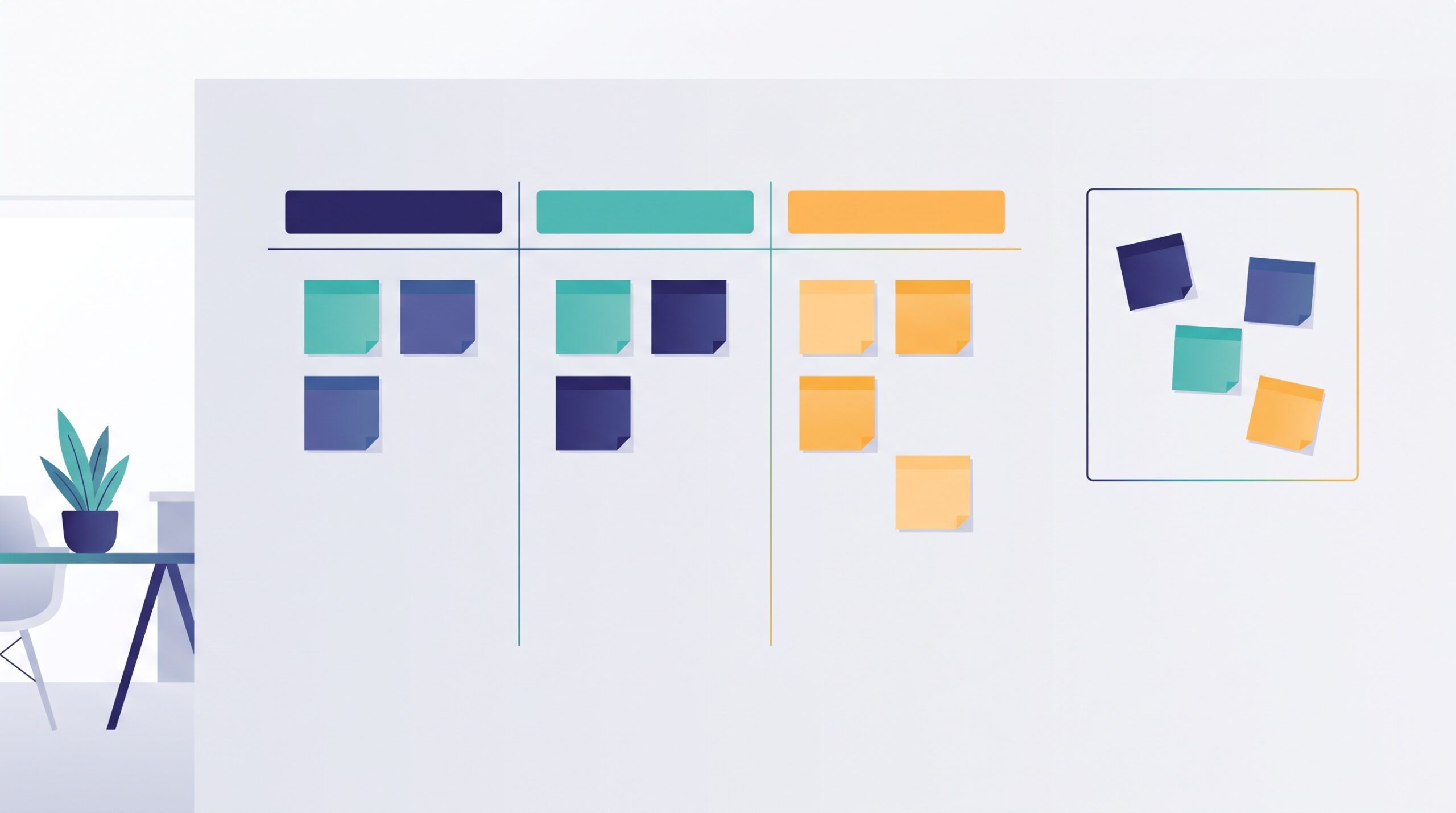
What a Parking Lot Actually Is
A parking lot is a dedicated area on your kanban board, set apart from your active columns, where you capture ideas, requests, and improvements you are not ready to act on yet. It might be a single column on the far right, a separate lane at the bottom, or a small standalone board. The format matters less than the rule behind it: nothing in the parking lot is being worked on. It is a holding pen, not a to-do list.
Think of it like the real thing. A parked car isn’t going anywhere, but it is safe, accounted for, and ready to drive when you need it. That is exactly what you want for a stray idea: out of traffic, but not gone.

Why a Mental Note Isn’t Enough
Most of us try to hold these ideas in our heads. That fails in two directions at once. Either we forget the idea entirely — and lose something genuinely valuable — or we can’t forget it, and it nags at us all afternoon, splitting our attention while we try to work. Psychologists call that lingering pull of an unfinished thought a kind of open loop, and open loops are exhausting.
Writing the idea down closes the loop. The moment it is safely captured somewhere you trust, your brain relaxes and lets it go, because it knows the idea will be there later. A parking lot is simply the most visible, reliable place to put it — right on the board you already look at every day, instead of buried in a note app you’ll never reopen.

Parking Lot vs. Backlog: Not the Same Thing
It’s worth being clear about the difference, because they’re easy to confuse. Your backlog is committed work — things you have decided to do, just not yet. A parking lot is a step earlier: it holds things you might do, that you haven’t committed to at all. The backlog is a queue; the parking lot is a maybe.
Keeping them separate protects both. If you dump every half-formed idea into your backlog, it swells into an intimidating wall of noise and stops being a plan you can actually work through. If you carefully capture requests into a dedicated intake column, you already understand this instinct — the parking lot is its cousin for ideas that aren’t even requests yet. For handling incoming work specifically, a structured lane like the one in the intake lane approach pairs well with a parking lot for looser, someday thinking.

How to Set One Up
Setting up a parking lot takes about two minutes. Add a clearly labeled column or lane to your board, off to the side of your active flow so it never gets confused with work in progress. Give it a name that signals its purpose to everyone — “Parking Lot,” “Someday,” or “Not Now” all work. Then make one rule explicit: cards here are not being worked on, and no one pulls from here without a deliberate decision.
Keep the cards light. A parking lot card doesn’t need a full description, a due date, or an owner — just enough for you to remember what you meant. The whole point is speed: you should be able to capture an idea in seconds and get straight back to what you were doing.
Review It, or It Becomes a Junk Drawer
Here is the part most people skip, and it’s the part that makes or breaks the whole system. A parking lot only works if you review it on a regular rhythm — weekly for a personal board, or during a planning session for a team. Without that, it quietly rots into a junk drawer nobody opens.
The review is simple and a little ruthless. Walk each card and make one of three calls: promote it into your backlog because its time has come, delete it because it no longer matters, or leave it parked for now. That last option is a real, honest choice — some ideas are meant to wait. This is a natural thing to fold into a broader planning routine, the same way you’d map bigger goals when you build a planning board for the quarter ahead.
The Payoff: Focus Without Fear
The real gift of a parking lot isn’t organization — it’s peace of mind. When you trust that every good idea has a safe place to land, you stop feeling like you have to act on things the instant they occur to you. You can stay on today’s work without the low-grade anxiety of “I’ll forget this if I don’t do it now.”
That is the whole promise of a good visual system: you get to hold fewer things in your head and more things on the board. Give your someday ideas a parking spot, review it honestly, and you’ll protect both your focus today and your best thinking for tomorrow. If your ideas are still scattered across sticky notes, emails, and half-remembered conversations, pulling them into one visible place — even something as simple as turning your inbox into a board — is the first step toward a system that finally sticks.