Think about the last request that slipped through the cracks on your team. It probably did not fail because someone refused to do it. It failed because it never landed anywhere. A client mentioned it at the end of a call, a colleague meant to write it down, and by the time it surfaced again it had become a problem instead of a task. Small teams almost never drop work on purpose. They drop it because requests arrive from a dozen directions at once — email, chat, a phone call, a hallway ask, a sticky note on someone’s monitor — and there is no single place for all of them to go. An intake lane is the fix, and it is one of the smallest changes you can make to a board for one of the biggest gains in trust.

Why Scattered Requests Always Leak
The reason work goes missing is not laziness or bad memory; it is that every channel is its own little island. An email lives in one person’s inbox. A text lives on one person’s phone. A verbal ask lives in one person’s head until it evaporates. None of those places is visible to the team, and none of them is a commitment — it is just a message sitting somewhere, waiting for the receiver to remember to act. Multiply that by five channels and three people and you have a system almost designed to lose things. Worse, the requests that leak are rarely random. They tend to be the informal, spoken, “quick favor” asks — exactly the ones from the people you least want to disappoint. The problem was never the team’s diligence. It was the absence of a shared front door.
One Front Door: The Intake Lane
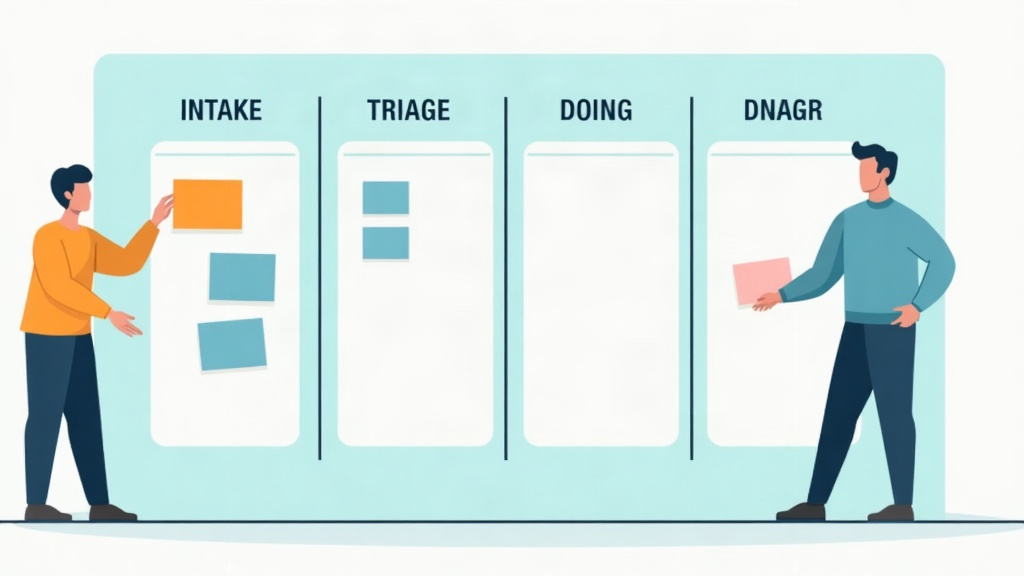
An intake lane is simply a single column at the left of your board — call it Intake, Inbox, or New Requests — where every incoming ask becomes a card the moment it arrives, no matter which channel it came through. Someone emails a request? It becomes a card in Intake. A client asks for something on a call? Card in Intake, before you hang up. A teammate has an idea in the hallway? Card in Intake. The rule is deliberately dumb and absolute: if it is a request, it goes in one place, immediately, in the requester’s rough words. You are not deciding anything yet. You are not committing to anything yet. You are only making sure the request exists somewhere the whole team can see it, so it can never again quietly vanish between an inbox and a good intention.
Capture Just Enough at the Door
The temptation is to make intake elaborate — forms, required fields, categories. Resist it, because friction at the door defeats the purpose. If capturing a request takes two minutes, people will skip it under pressure and you are back to leaks. A good intake card needs only enough to triage it later: who asked, what they actually need (in plain language, not your interpretation), when they need it, and any hint of how urgent it is. That is it. You can enrich the card later when you decide to act on it — if you decide to act on it. Keeping the door low and wide is what makes the whole team willing to use it, and a lane everyone uses beats a perfect form nobody fills in. This is the same principle behind designing cards your team can actually use: capture what you need to make a decision, and no more.
Triage the Lane, Don’t Let It Rot
An intake lane only works if it is emptied on a rhythm. Left alone, it stops being a front door and becomes a second inbox — a place things go to be forgotten with extra steps. The fix is a short, regular triage: once a day, or at least at a set time, someone runs down the intake cards and makes one decision on each. Does this become real work and move to the backlog or straight into the flow? Does it wait for a defined later? Does it belong to someone else entirely and get passed on? Or is it a polite no? Every card gets a verdict; nothing sits undecided. Because you are handling the whole lane in one focused pass rather than reacting to each ping as it lands, triage is fast and calm — and it doubles as a natural moment to refill the board without overloading the team, pulling in new work only as capacity allows.

Where Intake Ends and the Backlog Begins
It helps to be clear that the intake lane is not your backlog. Intake is raw and unfiltered — everything anyone has asked for, in the state it arrived. The backlog is deliberate — the work you have actually decided to do, ordered by what matters. Triage is the gate between them, and keeping the two separate is what stops your backlog from swelling into an unusable graveyard of half-formed asks. Most intake cards should not survive into the backlog unchanged; some get sharpened, some get merged, and plenty get a friendly decline. If you have ever watched a backlog balloon until no one trusts it, the missing piece was usually this filter. Keeping intake and backlog distinct is the practical version of the rule that your backlog is not a to-do list.

The Quiet Benefit: Fewer Interruptions
There is a second payoff that owners feel almost immediately. When there is a known front door for requests, you can stop treating every incoming ping as an emergency to handle right now. “Drop it in intake and I’ll get to it at the next review” is a complete, honest answer — it acknowledges the request, guarantees it will not be lost, and protects the deep work happening at that moment. Over time the whole team learns the rhythm: requests are captured instantly and decided on a schedule, not fought over in real time. That is how an intake lane quietly becomes a tool for protecting your team’s capacity without anyone having to be the bad guy. The work still gets seen. It just stops running your day.
You do not need new software or a big process to start. Add one column to the left of your board, make the rule that every request lands there the instant it arrives, and spend five minutes a day emptying it. That single lane turns a scattered stream of asks into a visible, decidable queue — and the request that used to slip through the cracks now has nowhere to hide. A simple kanban board is all it takes to give every incoming ask a home.