You know the moment. It’s Thursday night, and nobody renewed the car registration, the permission slip is still in a backpack, the dishwasher’s been “about to be emptied” since breakfast, and somebody says the sentence that starts every household argument: “Wait — I thought you were going to do that.” Running a home is a project. A messy, never-ending, multi-person project with no manager. And it turns out the same humble tool that keeps work projects from descending into that exact chaos works just as well on the kitchen wall. It’s called kanban, and you don’t need to be a project manager to use it at home.
Why a board beats a list (and beats your memory)
Most homes run on two systems: a scribbled to-do list, and one person’s overloaded brain. Both fail the same way. A list tells you what needs doing but nothing about who’s got it or whether it’s actually moving. And the brain — usually one person’s — carries the invisible weight of remembering it all, the famous “mental load” that quietly exhausts whoever’s stuck holding it.
A kanban board fixes both by doing one simple thing: it makes the work visible. You can see everything that needs doing, who’s doing what, and what’s genuinely finished — all in one glance, out in the open, where it belongs to the whole household instead of living in one head. That shift, from invisible to visible, is where almost all the magic comes from.

Start embarrassingly simple: three columns
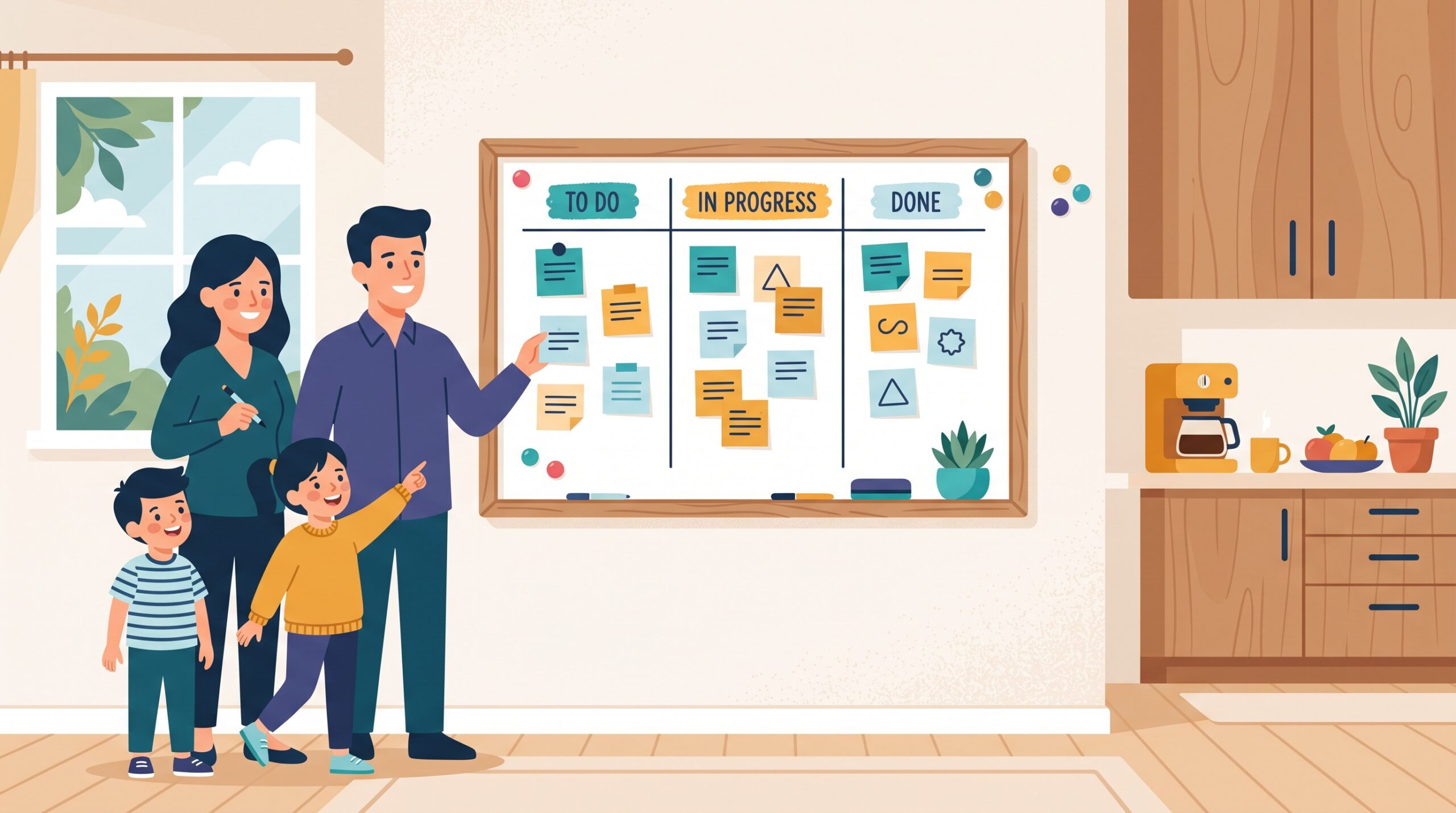
Resist every urge to build something elaborate. Your first family board needs exactly three columns:
- To Do — everything that needs doing.
- Doing — what someone is actively on right now.
- Done — finished (and yes, moving a card here is weirdly satisfying, which is the point).
Each task — “renew car rego,” “book dentist,” “fix the back gate,” “sign the permission slip” — is one card that moves left to right as it gets done. That’s the entire system. A board you’ll actually keep up beats a beautifully color-coded fortress you’ll abandon by week two — the number-one reason boards get abandoned is starting too complicated, and home boards die that way even faster than work ones.
The one rule that makes it work: every card has an owner
Here’s where home boards live or die. A task with no name on it is a task nobody does — it’s the “I thought you had it” problem in physical form. So the non-negotiable rule is: every card in “Doing” belongs to a specific person.
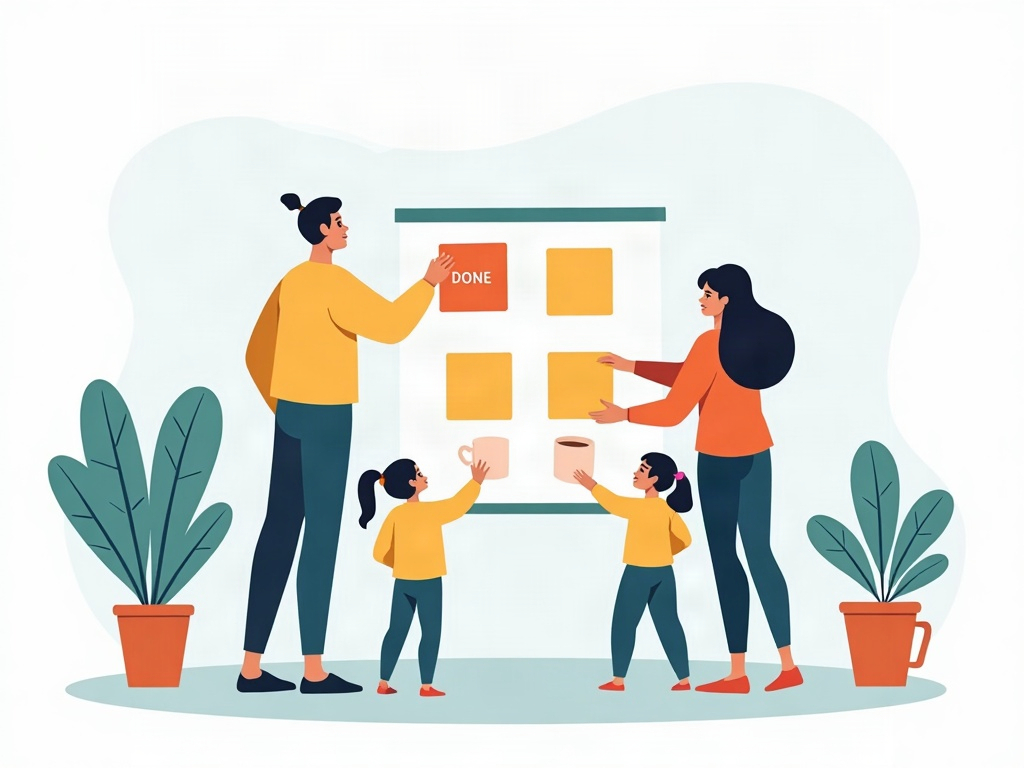
The easiest way is to give each family member a color or a simple initial, and tag each card. Now “someone should take out the bins” becomes “that green card is Dad’s,” and the ambiguity that fuels most household resentment just evaporates. A light touch of color here is the whole trick — the same simple color-coding approach that keeps a work board readable keeps a family board from turning into a guilt-trip rainbow. Kids, by the way, love this part. A card with their name on it, and the little ceremony of moving it to Done, turns chores into something closer to a game than a fight.
What to actually put on it
Don’t try to capture every molecule of home life — that’s how a board becomes overwhelming. Aim it at the stuff that actually causes friction:
- One-off tasks that keep slipping: appointments to book, forms to sign, that lightbulb, the thing to return.
- House projects that are too big to “just do” — declutter the garage, plan the trip, repaint the hallway. Break these into a few smaller cards so they actually move instead of looming.
- The shared weekly stuff — groceries, meal plan, whose turn for the school run.
Recurring daily chores are a judgement call. Some families love having “dishes” and “laundry” as cards that reset; others find that clutters the board and keep it for the non-routine things only. Start with the slippery one-offs and projects, and add routines later only if you feel their absence.
Keep it alive with a five-minute weekly reset
A board only works if people touch it, and the easiest way to guarantee that at home is a tiny recurring ritual. Once a week — Sunday evening, Saturday over coffee, whenever — the household spends five minutes at the board together: clear out the Done pile, add what’s coming up, and make sure every active card has a name on it. That’s it.
This little huddle does something a nagging text never will: it turns planning the week into a shared act instead of one person assigning jobs to everyone else. It’s also your moment to prune — if cards have been sitting untouched for weeks, either someone commits to them or they come off the board. A quick weekly tidy, the home version of a backlog grooming habit, is what keeps the board trustworthy. And a board people trust is one they’ll keep using.
On the fridge or on a screen?
Both work; pick the one your family will actually look at. A physical board — a whiteboard or just sticky notes on the fridge — is brilliant for families with kids because it’s always visible and nobody needs an app or a login to move a card. A digital board wins when people are out of the house a lot, when you want it on everyone’s phone, or when tasks have details and dates attached. Some families run both: the fridge for daily chores, a shared app for the bigger projects and anything with a deadline. There’s no wrong answer — the only mistake is choosing the one that ends up ignored.
However you build it, the payoff is the same. The mental load stops living in one exhausted person’s head. “I thought you had it” loses its power, because now you can both just look at the board. And the house runs a little more like a team and a little less like a series of near-misses. Start with three columns and a name on every card, keep it stupidly simple, and give it a week — whether it’s sticky notes on the fridge or a shared kanban board on your phones, you’ll wonder how your household ever ran without being able to just see it.