The best hire you will ever lose is the one who accepted another offer while your résumé pile sat untouched for a week. Small teams rarely miss out on great people because the candidates were weak. They miss out because the hiring process was slow, invisible, and run out of a cluttered inbox. A promising applicant sends in a strong résumé, you mean to set up a call, and then a busy stretch buries the email. By the time you dig it back out, they have taken a job somewhere that moved faster. If your hiring lives in your head and a folder of attachments, this is costing you good people right now. A kanban board fixes it the same way it fixes any messy process: it turns every candidate into a visible card that has to move, so no one quietly goes cold.
Hiring is a flow problem, not a paperwork pile
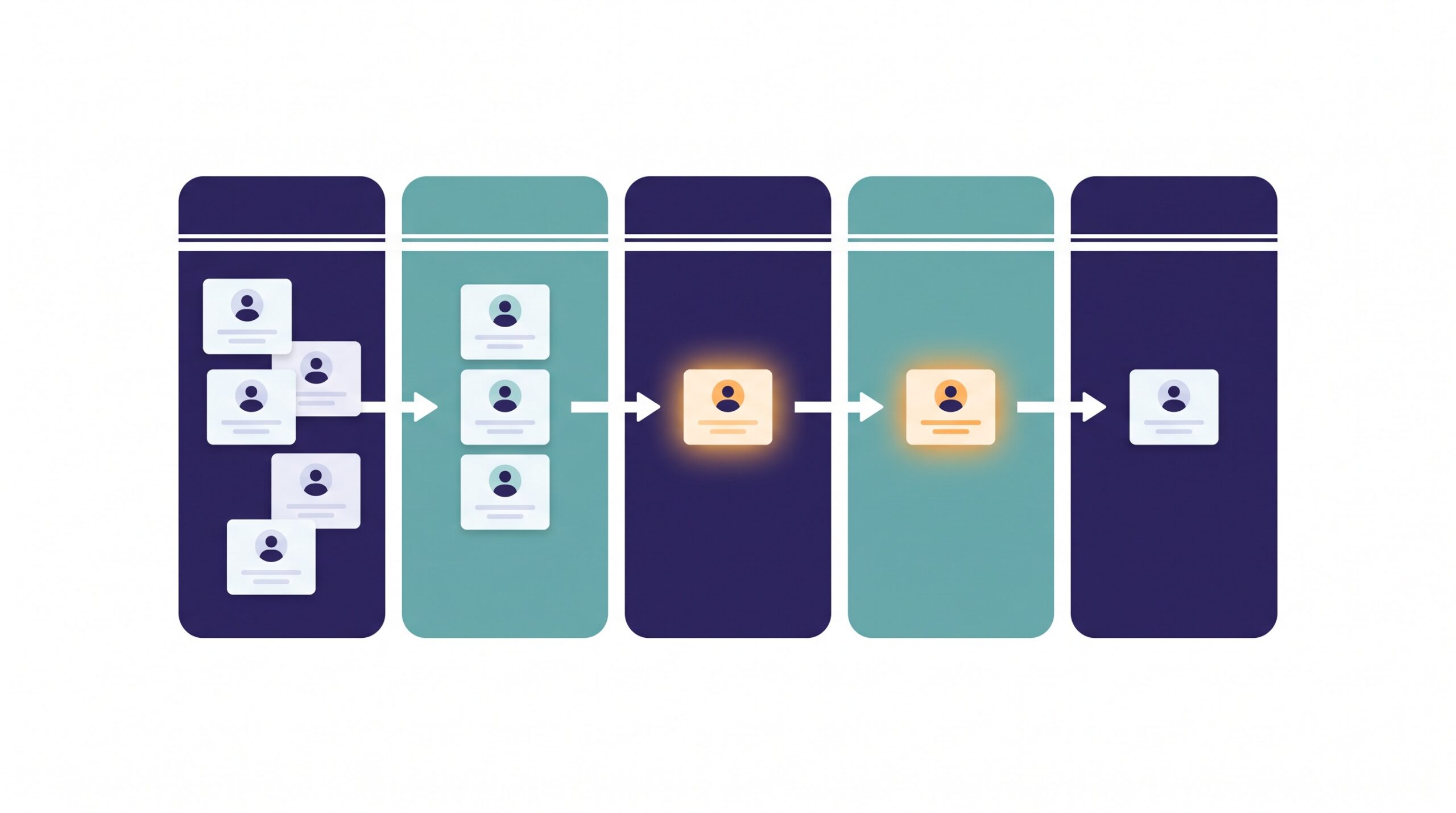
We tend to think of hiring as a matter of judgment, of finding the right person. In a small business, though, the thing that most often decides whether you land that person is far less glamorous: it is whether every applicant gets reviewed, contacted, and moved along in a reasonable time, without falling through a crack. That is a flow problem, not a talent problem. A candidate enters at one end as a stranger and, if all goes well, exits the other end as a new team member, passing through a handful of predictable steps on the way. This is exactly the kind of work a kanban board was made to show. It is the same insight behind treating any pipeline as visible flow rather than a to-do list, whether you are running a sales pipeline on a board or a stack of applicants.
Seeing it this way is a relief, because it means you do not need expensive recruiting software or an HR department to hire well. You need a board, a clear set of stages, and the discipline to keep the cards honest.
Turn your hiring stages into columns
Start by naming the real steps a candidate goes through in your hiring process, then make each one a column. For most small teams it looks something like: Applied → Screening → Phone Screen → Interview → Reference Check → Offer → Hired, with a Not a Fit area off to the side. The exact names matter less than that they match how you actually decide. A freelancer bringing on their first contractor might collapse this to four columns; a growing shop hiring for several roles might add a “working interview” step. Resist the urge to invent a stage for every possible situation. A board with a dozen columns is as useless as no board at all.
The payoff is immediate. The moment your applicants are laid out across these columns, you can read the health of your search at a glance: a wall of cards stuck in Screening tells you no one has actually reviewed the résumés yet; a thin Applied column warns you your job post is not reaching enough people to fill the role.

One card per candidate, and what belongs on it
Every applicant gets exactly one card, and that card has to carry enough for you to act without reopening a chain of emails to remember where things stand. At a minimum, a candidate card should answer four questions: who owns the next step, what that next step is, when it is due, and which role they are up for. The next action line is the single most valuable thing on the card. Not “waiting to hear back” but “send interview invite by Wednesday.” A link to the résumé and a note of where they came from rounds it out, and follows the same principle as deciding what belongs on any kanban card: enough to act, not so much that no one reads it.
Add a follow-up date and you have built yourself a reminder system for free. When a card’s date arrives, it is asking for your attention. That one habit, every active candidate has a dated next step, eliminates the most common way small teams lose great people, which is simply forgetting to reply in time.

Don’t run more openings than you can handle
Here is the counterintuitive part: trying to fill four roles at full tilt is how you fill none of them well. When a dozen candidates across several openings are all half-worked, each one gets a fraction of your attention, replies get slow, and strong applicants drift off while you are busy juggling. Putting a cap on how many candidates sit in your active stages, a work-in-progress limit that stops you starting more than you can finish, forces a healthier rhythm. You focus on driving the people already in the pipeline to a clear yes or no before pulling more in. And counting a “no” as progress matters here too: moving a candidate to Not a Fit is not a failure, it is attention freed up for someone who could actually get the job.
Move candidates forward on merit, not momentum
It is tempting to advance a card just because time has passed or you had a pleasant chat. Resist that. A stage should mean something specific and true. A candidate moves to Interview because they cleared the phone screen on the merits, not because the calendar filled up. Letting a card advance only when the step behind it is genuinely earned keeps the board honest, and an honest board tells you the truth about your shortlist instead of what you hoped for. The flip side is just as important: never let a strong candidate sit still. A great applicant who hears nothing for ten days assumes they did not get it and moves on, so a card parked in one column is a decision you owe them, not a pause.
Not every candidate needs the same speed
Some applicants cannot wait. A standout with the exact experience you need is probably interviewing elsewhere this week, while a maybe-candidate you are keeping warm can sit a few days without harm. Treating them the same is how you lose the best one. Flag your standouts to be worked first, run solid applicants at a steady pace, and keep the long shots in a low-effort lane you revisit when time allows. The board makes that priority visible so the person you most want to hire never gets buried under routine screening. Speed is not rudeness here; it is respect, and it is often the deciding factor when a great candidate is choosing between you and someone slower.
Read the board to catch candidates going cold
The real value of a visual pipeline shows up over time. A card that has not moved in a week is not neutral. It is a candidate quietly cooling off, and on a board you can see it aging in place. Watching how long cards sit is the hiring version of reading what your aging cards are trying to tell you. An applicant stuck in Interview for two weeks needs a decision now, not a shrug next month about why the role is still open. Make a habit of scanning the board for the oldest card in each column and asking one question: what is the single next thing that would move this person forward? That five-minute review, done twice a week, saves more good hires than any new job board.
From accepted offer to a great first day
The board does not stop the moment someone says yes. An offer accepted is a handoff, and the smoothest small teams let the last column flow straight into onboarding so the new person does not land to silence and a shrug. Keep a short list of first-week essentials ready so the same board that tracked the search can carry into onboarding a new team member without the overwhelm. The candidate you worked so hard to land forms their lasting impression of you in that first week, and a little visible structure is what turns a good hire into a good start.
The takeaway
You do not need an applicant-tracking system or a recruiter to stop losing good people to a slow, invisible process. You need your hiring out in the open where it can be worked. Name your real stages as columns, give every applicant one card with a dated next action, do not run more openings than you can handle, advance candidates only on merit, fast-track the standouts, and watch for the ones going cold. Do that and your hiring stops depending on what you happen to remember on a busy day and starts depending on a system that keeps every candidate moving. A simple kanban board is all it takes to turn a stack of résumés into a pipeline you can actually see.