The daily standup has a terrible reputation, and most of the time it has earned it. You know the version: eleven people crammed into a room, someone reading a status report off their laptop, three side conversations breaking out about a bug, and twenty-five minutes later everyone shuffles back to their desks having learned almost nothing. No wonder people start finding reasons to skip it.
But the standup itself isn’t the problem. A tight, well-run standup is one of the cheapest and most valuable rituals a small team has. It keeps everyone pointed in the same direction, catches problems while they are still small, and does it all before the day gets busy. The trick is running it in ten minutes and making it about the work, not about performing productivity for the boss. Here is how.

Keep it to ten minutes, and mean it
The single most important rule is the time box. A standup should take ten minutes or less for a team of up to eight or nine people. If it consistently runs longer, something is wrong, and it is almost always the same thing: the meeting has quietly turned into a place to solve problems instead of a place to surface them.
Set a genuine limit. Some teams literally stand up the whole time, because standing is uncomfortable enough to keep things brief. Others put a ten-minute timer on the table. The mechanism matters less than the commitment. When the timer goes off, the meeting is over, even if you didn’t get to everything. You will be amazed how quickly people learn to be concise once they know the clock is real.
Walk the board, not the room
The classic standup format has each person answer three questions: what did I do yesterday, what will I do today, what is in my way. It works, but it has a flaw. It puts the focus on people justifying their time rather than on the actual state of the work. On a bad day it feels like a series of tiny performance reviews.
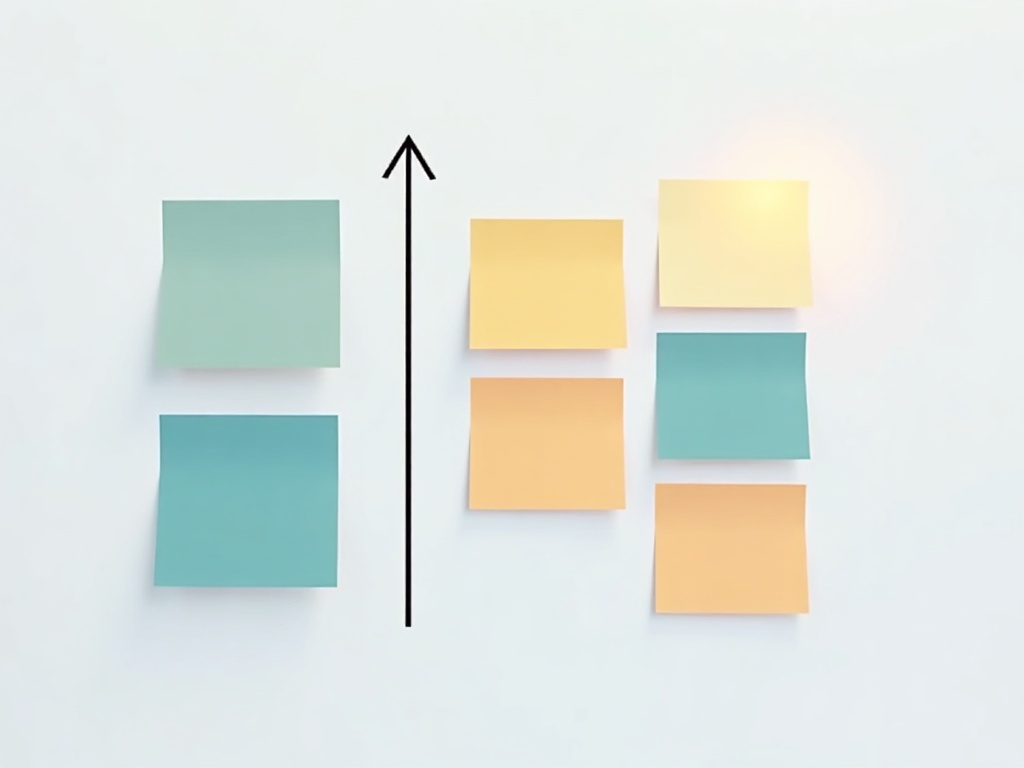
A better approach for any team with a kanban board is to walk the board instead of going around the circle. Start at the right-hand side, at the work closest to done, and move left toward the not-yet-started. For each card that is in play, ask a simple question: what does this need to move forward? This flips the whole tone. Now you are talking about the work and how to get it across the line, not about who did what. Cards near the finish line get attention first, which is exactly right, because finishing work is almost always more valuable than starting more of it.
Surface blockers, don’t solve them
The most common way a standup blows past ten minutes is that someone mentions a problem and the whole group dives in to fix it right there. Suddenly four people are debating an approach while the other five stand around checking their phones. It feels productive. It is not, at least not for the people who aren’t involved.
The rule is simple: the standup is for naming blockers, not resolving them. When someone raises an obstacle, acknowledge it, note who needs to be involved, and park it. The phrase to keep in your back pocket is “let’s take that offline.” As soon as the standup ends, the two or three people who actually need to solve the problem can peel off and do so, without holding everyone else hostage. Your board makes this easy: flag the blocked card so it is visible, and the follow-up conversation has an obvious home.

Same time, same place, every day
Standups thrive on rhythm. Pick a time and protect it. Early in the day works best, because it sets up the hours ahead and catches problems before they fester, but the exact time matters less than the consistency. A standup that happens at 9:15 sharp every single day becomes a habit nobody has to think about. One that floats around the calendar becomes a meeting people forget and resent.
Consistency also does quiet work on your culture. When the standup always happens, showing up on time and being ready becomes the norm rather than something the manager has to nag about. The ritual carries itself.
Make it for the team, not the manager
Here is the mindset shift that fixes most broken standups. The meeting is not a status update for the manager. It is a coordination moment for the team. The difference shows up in a dozen small ways. When it is for the manager, people report upward, speak carefully, and pad their answers. When it is for the team, people talk to each other, ask for help, and hand off work in real time.
If you are the person leading the team, the best thing you can do is talk less. Let the board drive the conversation, let teammates raise their own blockers, and resist the urge to turn every card into a check-in on the person holding it. Your job is to keep it moving and keep it short. A standup where the manager barely speaks is usually a standup that is working.

What good looks like
A healthy standup has a texture you can feel. People arrive on time and ready. The board is up and everyone can see it. You move quickly from card to card, the whole thing has a slight forward lean, and when a problem surfaces it gets named and parked rather than chewed over. Ten minutes later you are done, a couple of people have quietly agreed to sort something out afterward, and everyone knows what the day looks like.
If your standups don’t feel like that yet, don’t scrap the ritual. Fix the format. Tighten the time box, walk the board instead of the room, park the blockers, and hand the meeting back to the team. Do that for a week or two and the standup stops being the meeting people dread and becomes the one they would miss if it went away.
And if your board is what the whole team gathers around each morning, it is worth keeping it clean and current, so a ten-minute walk across it actually tells the truth about your work.