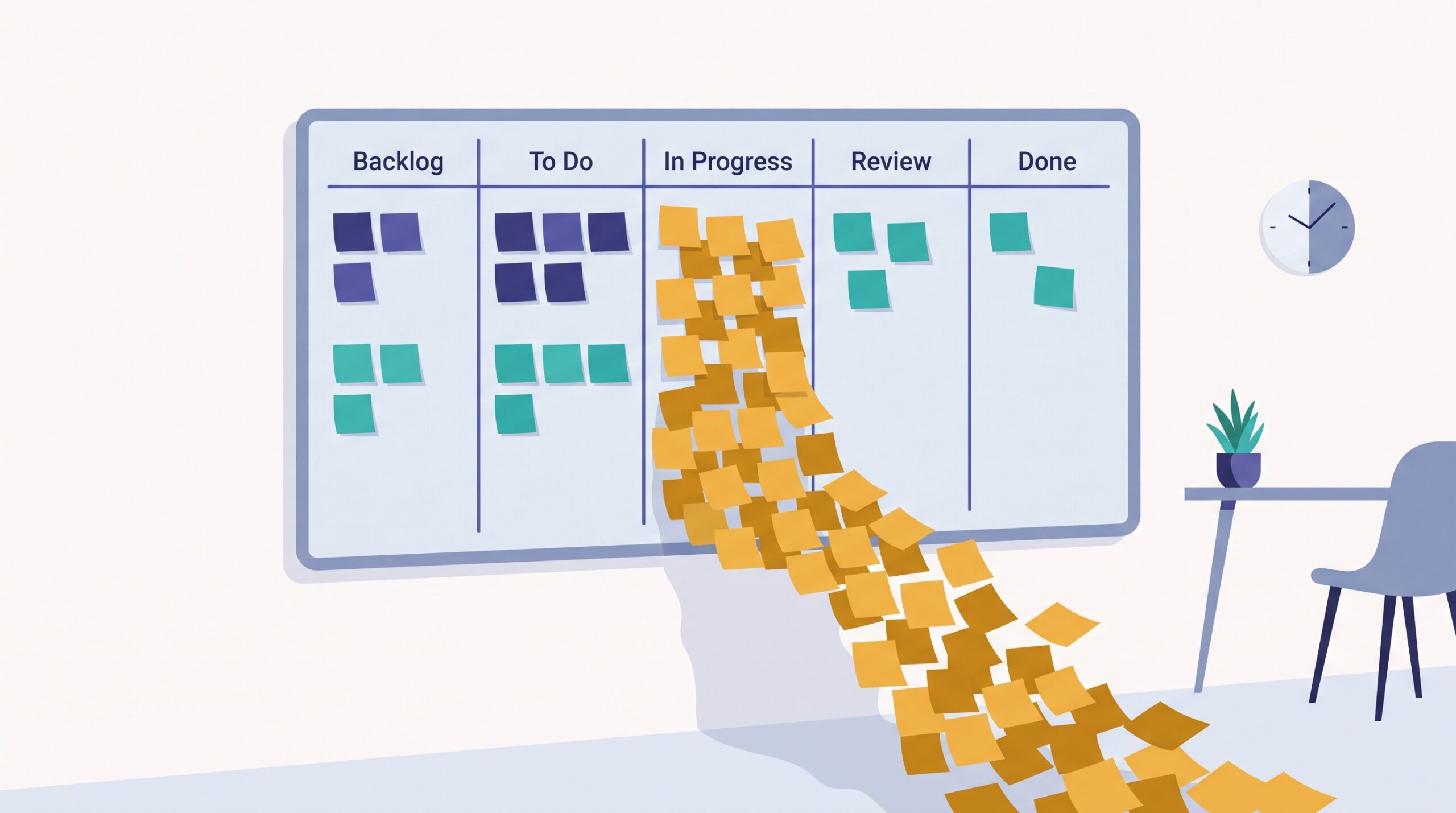
No project ever gets derailed by one big, obvious decision. It gets derailed by a hundred small ones: a “can you also add…,” a “while you’re in there…,” a “the client just wants one more tweak.” Each request is reasonable on its own. Together, they quietly double the work — and by the time you notice, the deadline is a week gone and nobody can point to the moment it happened.
That’s scope creep. And the reason it’s so dangerous for small teams is that it’s invisible. The work grows, but the plan on paper still says the same thing it said three weeks ago. The good news: a kanban board is one of the simplest tools for making that growth visible — early enough to do something about it. Here’s a practical system.
What Scope Creep Actually Looks Like
Scope creep isn’t the same as changing your mind. A deliberate decision to expand a project — with a new deadline and everyone agreeing — is just planning. Creep is what happens when the work expands and nobody decides anything.
It usually wears one of these disguises:
- The friendly add-on. “Since you’re already building the homepage, can you also do the contact form?”
- The vague requirement that fills in later. “Make it look professional” turns into six rounds of revisions.
- The gold-plating. Someone on the team keeps polishing a feature nobody asked to perfect.
- The rescue mission. A quick favor for another department that swallows two days.
None of these are bad in isolation. The problem is they never get counted. They ride along inside existing tasks, so the total workload grows while the board still shows the original plan.
Why a Kanban Board Catches Creep Early
The whole point of a kanban board is that work is only real when it’s a card. If it isn’t on the board, it isn’t being tracked, estimated, or scheduled. That single rule is your best defense against creep, because scope creep survives on being uncounted.
When every piece of work must become a visible card before anyone touches it, three things happen automatically. New requests stop hiding inside old tasks. The size of the project becomes obvious at a glance — a backlog that keeps growing is impossible to ignore. And you get a natural moment to ask the only question that matters: “Is this in scope, and if so, what moves to make room?”

Make New Work Visible: The Intake Rule
Set one non-negotiable rule for your team: no new work starts without a card. When a request lands — by email, in a hallway, over chat — it goes into a dedicated Intake or New Requests lane before anyone lifts a finger.
This feels bureaucratic for about a week, and then it becomes the thing that saves you. A request sitting in Intake is a request you can actually reason about. You can ask: Does this belong in the current project or the next one? Who asked, and by when? What does it push out if we say yes?
Making the ask visible also changes the conversation with clients and colleagues. “Sure, I’ll add that” becomes “Great — I’ll put it on the board. Adding it moves our launch to Friday. Want me to make that trade?” You’re not saying no. You’re making the cost of yes visible.
Split the Card, Don’t Stretch It
Here’s the habit that quietly kills most creep: when new work attaches itself to an existing task, resist the urge to just do it. Split it into its own card instead.
Say a card reads “Build the pricing page.” Mid-build, the client asks for a comparison table and a FAQ section. The tempting move is to keep working — it’s all the same page, right? But now that one card silently holds three jobs, and it’s going to sit in progress twice as long as anyone expected.
Split it: “Comparison table” and “FAQ section” become their own cards in the backlog. Now the extra work is countable. You can see it, sequence it, and decide whether it ships now or after launch. A card that keeps growing is a card that will keep aging in your In Progress column while you wonder why nothing’s finishing.

Use WIP Limits as a Natural Speed Bump
A work-in-progress (WIP) limit — a cap on how many cards can sit in a column at once — is usually sold as a focus tool. It’s also a superb scope-creep alarm.
When your “In Progress” column is capped at, say, three cards, a new request can’t just slip in. Something has to finish or move first. That forced pause is exactly the moment where scope decisions should happen. Instead of quietly absorbing the extra work, the limit makes someone say out loud: “We’re full. To take this on, what comes off?”
That’s the entire trick. Creep thrives when there’s always room for one more thing. A WIP limit removes the phantom capacity that lets small additions pile up unnoticed.
The Weekly Scope Check
Once a week — 15 minutes is plenty — stand in front of the board and look at it as a whole, not card by card. You’re hunting for growth, so ask three questions:
- Is the backlog bigger than last week? If cards keep arriving faster than they leave, scope is expanding whether you approved it or not.
- Are cards getting fatter? Tasks that quietly gained sub-items are creep in disguise. Split them.
- What’s aging in progress? A card stuck for days often means the work grew after it started.
This is the moment to make the real decision you’ve been dodging all week: cut something, move a deadline, or add resources — on purpose, with everyone in the room. Doing it weekly means you catch a molehill instead of discovering a mountain.
When Scope Change Is the Right Call
None of this means locking the project in concrete. Requirements change, clients learn what they actually want, and a good idea mid-project can be worth more than sticking to the plan. The goal isn’t to prevent change — it’s to make change a decision instead of an accident.
When a genuinely worthwhile addition appears, the answer is simple: turn it into a card, be honest about what it costs, and renegotiate. Maybe the deadline moves. Maybe something else drops to the next phase. Maybe the client happily pays for the extra work. Any of those is fine. What’s not fine is silently absorbing it and hoping the math works out — because it never does.
The takeaways: make every request a visible card before work starts; split new work into its own card instead of stretching an existing one; let WIP limits force the trade-off conversation; and spend 15 minutes a week watching the board for quiet growth. Do those four things and scope creep stops being the thing that sinks you — it becomes just another decision you get to make with your eyes open. A clear board won’t say no for you, but it will always show you the cost of saying yes.