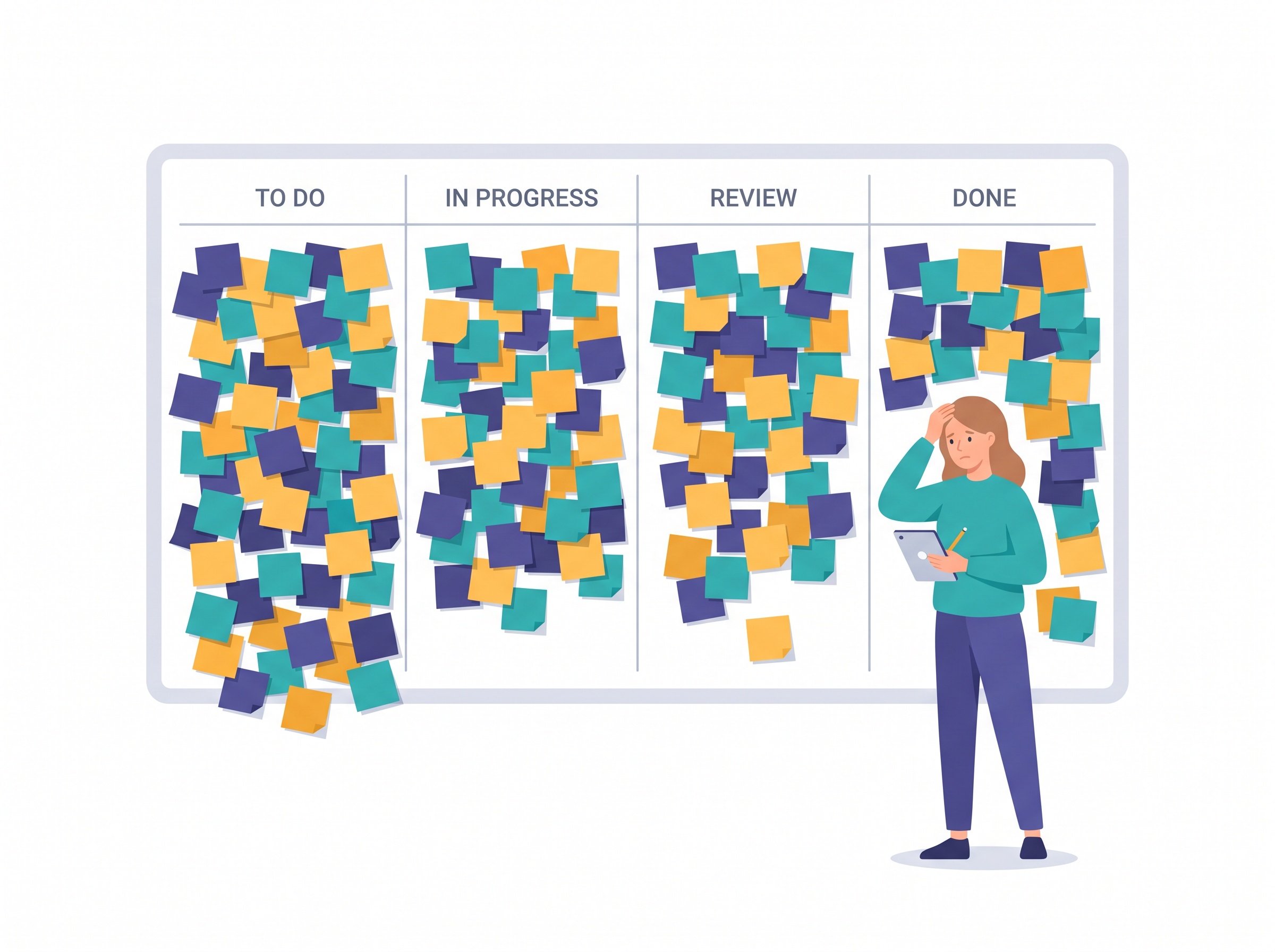
Here is a pattern that quietly wrecks good kanban boards. You start with a clean board and a sensible flow, and it works beautifully for a few weeks. Then a client mentions a feature they would love “someday.” You have an idea for a newsletter in the shower. A teammate drops a “we should really look into this” in a meeting. Each one is a genuinely good idea, so onto the board it goes. Three months later your To Do column is a graveyard of fifty cards, and you cannot tell which three actually matter this week. The board that was supposed to show you reality now hides it.
The instinct is to blame yourself for poor discipline, or to start deleting cards and feeling guilty about it. Neither is the real fix. The real fix is to admit that two very different kinds of work were never meant to live on the same board — and to give the slower kind a home of its own.
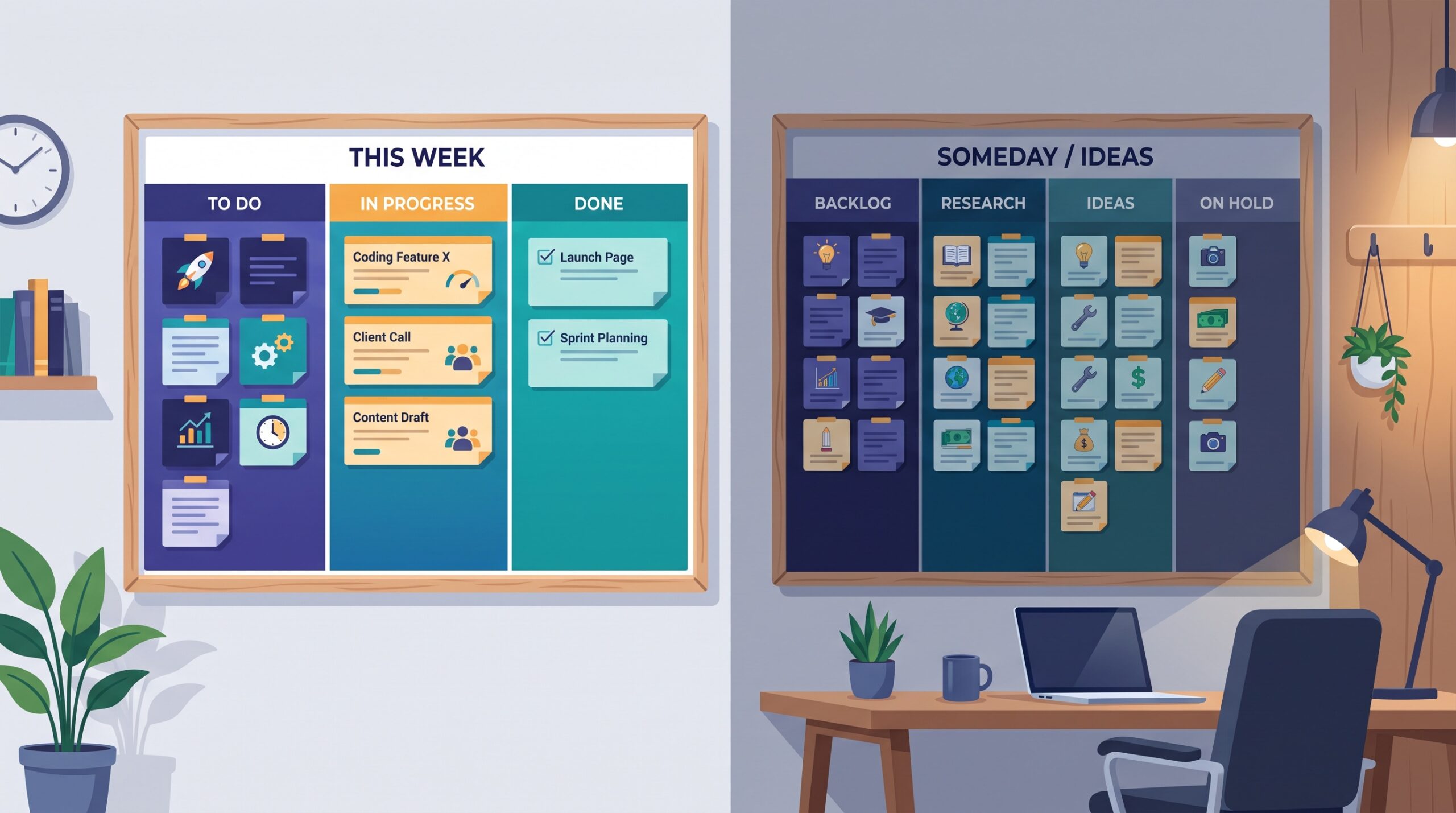
Two kinds of work, one overloaded board
Your active work and your ideas are different species. Active work is committed: it has a rough timeframe, someone owns it, and it is moving. The whole point of a kanban board is to show that movement — to make the state of real, in-flight work visible at a glance so you can spot what is stuck and decide what is next.
Ideas are the opposite. They are uncommitted by definition. A someday idea has no owner yet, no timeframe, and no business taking up space next to a card that is due Thursday. It is not that the idea is worthless — it is that it is not this week’s problem, and parking it in the middle of this week’s problems forces your eyes past it dozens of times a day for no benefit. Every one of those glances is a tiny tax on your attention.
When you mix the two, the board loses the one thing it was good at: telling you the truth about your current load at a glance. A To Do column with fifty cards does not say “you have a lot to do.” It says “this board can no longer be trusted,” and the moment a board cannot be trusted, people quietly stop looking at it.
What a second board actually is
A second board is not a second project to manage. Think of it as a parking lot, an incubator, or a someday-maybe list with columns. Its job is to hold every idea, request, and “we should look into this” safely out of sight of your active work, so you can capture it without cluttering your real board — and find it again when you are actually ready.
It moves on a completely different clock. Your main board you look at every day, maybe several times a day. Your someday board you look at once a week, or even once a month. Nothing on it is urgent; that is the entire point. Because it is slow, it can be messy without hurting you. It can hold a hundred cards and it does not matter, because you are not trying to track flow there — you are just keeping ideas from evaporating.
A simple structure is plenty. Many people run their someday board with just three columns: Raw Ideas for anything freshly captured, Shaped for ideas you have thought through enough to actually start, and Ready to Pull for the ones you would happily promote the moment you have capacity. You can add columns for themes — client requests, marketing, internal improvements — but resist the urge to over-engineer it. A parking lot does not need traffic lights.
The one rule that makes it work: promotion is deliberate
A second board only helps if ideas cannot sneak onto your main board on their own. The discipline is simple to state and surprisingly powerful: nothing moves from the someday board to the active board except by a deliberate decision, usually during a review.
This is the opposite of how cluttered boards happen. On a cluttered board, work arrives by drift — someone adds a card in the moment and it just sits there. With two boards, capture and commitment become separate acts. You capture freely and instantly onto the someday board, with zero guilt and zero friction, because capturing costs you nothing. But committing — pulling a card onto the active board — happens on purpose, when you have the capacity and have decided it is worth your focus this week. Capture is cheap; commitment is a choice.

Keeping the someday board from becoming a junk drawer
The honest risk is that your second board turns into a place where ideas go to die — a digital junk drawer you never open. That is fine, up to a point. A someday board you never look at is still better than a main board you cannot read, because at least your real work stays clear. But a little maintenance makes the second board genuinely useful instead of just a relief valve.
Give it a review cadence, even a loose one. Once a week or once a month, open the someday board and do three things. First, promote: is anything here worth pulling onto the active board now that you have capacity? Second, prune: are there ideas that were exciting a month ago and now clearly are not worth doing? Archive or delete them without ceremony — a decision to not do something is a real decision and it frees you. Third, shape: nudge a raw idea or two toward “ready” by jotting down what starting it would actually involve, so future-you can pull it without a running start.
That review is also the natural companion to your regular board check-in. If you already run a short weekly review of your active board, bolt a two-minute glance at the someday board onto the end of it. You are already in review mode; you are just widening the lens for a moment before closing it again.
When you do and do not need one
Not everyone needs a second board on day one. If your work is small and steady and your To Do column never swells past what you can read in a glance, a single board with a tidy backlog section is simpler and perfectly fine — and simpler is always the right default. The signal that it is time to split is specific: you notice you are scrolling past the same old cards every day, you feel a flicker of dread opening the board, or you genuinely cannot tell which items are live commitments and which are wishful thinking.
The second board pays off most for people juggling many incoming requests — freelancers fielding client ideas, team leads catching every “can we also” from stakeholders, solo operators whose own brains generate more ideas than any one person could ship. If that is you, splitting capture from commitment is one of the highest-leverage changes you can make, and it costs nothing but the decision to do it. It also pairs naturally with giving the active board a hard ceiling; if you have ever read about why work-in-progress limits keep a board honest, a someday board is the pressure valve that makes those limits livable — the overflow has somewhere safe to go.
The takeaway is small but it changes how a board feels to use. Your main board should answer one question cleanly: what is actually moving right now? Give it only the work you have truly committed to this week, and give everything else — every bright idea, every maybe, every not-yet — a quiet second home where it can wait without nagging you. Capture everything, commit to little, and review on a rhythm. Do that, and the board you look at every day goes back to telling you the truth, which is the only reason it was ever worth keeping. A board you can read in five seconds is a board you will still be using next year — and a simple second board, even a plain one, is usually all it takes to get there.