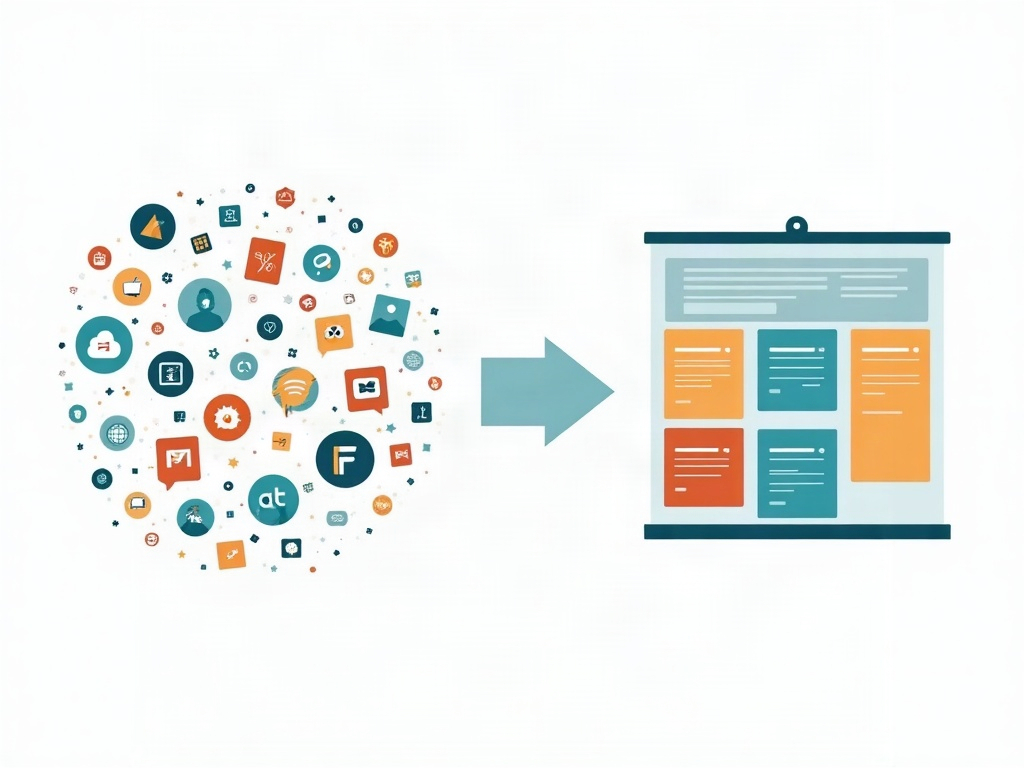
The scariest line item in a small business today is not the one you can see on the invoice, it is the AI tool three people on your team already depend on that no one ever wrote down. A designer signs up for an AI image app, someone in sales starts pasting client notes into a chatbot, a freelancer you work with runs everything through a transcription service you have never heard of. Each choice was reasonable, even helpful. But added up, you now have a stack of AI tools you did not approve, cannot budget for, and could not list if someone asked. People call this “shadow AI,” and it usually gets treated as a discipline problem to crack down on. It is not. It is a visibility problem, and AI tool sprawl is what happens when useful tools show up faster than anyone can track them. The fix is the same one that works for any messy, invisible process: put it on a board where you can see it.

Shadow AI is a workflow problem, not a rule-breaking problem
It is tempting to think tool sprawl means your team is going rogue. In reality, people reach for a new AI app because it solves a real problem in front of them, and asking permission felt slower than just doing the work. Punishing that instinct only pushes the tools further underground. The honest issue is that there is no simple, low-friction place for a new tool to land and become visible, so it stays a secret by default. That is a flow problem, and it looks a lot like the ones you already solve on a board. A tool enters as “something someone is trying,” and if it earns its place, it should graduate to “something we officially rely on,” passing through a couple of predictable checkpoints along the way. Seeing it this way is a relief, because it means you do not need an IT department or a heavy approval process. You need a board and a shared habit of putting new tools on it.
Turn your tool lifecycle into columns
Start with the real stages an AI tool passes through in your business, then make each one a column. For most small teams it is refreshingly short: Someone’s Trying It → In Regular Use → We Rely On This, with a Retired area off to the side for the ones you dropped. The first column is the important one, because it gives every new tool a legitimate front door. Instead of a subscription quietly appearing on a credit card statement, it appears as a card the moment someone starts experimenting. Nobody has to ask for permission to try something, they just have to make it visible. The exact names matter less than that they match how tools actually earn trust in your shop. The payoff is immediate: the moment your tools are laid out across these columns, you can read the state of your stack at a glance, the same way deciding where AI actually fits in your workflow gets easier once you can see it rather than guess at it.
One card per tool, and what belongs on it
Every AI tool gets exactly one card, and that card has to carry enough for you to make a decision without hunting through inboxes and billing portals. At a minimum, a tool card should answer five questions: who on the team owns it, what job it actually does, what kind of data it touches, what it costs, and whether anyone has signed off on it. The data it touches line is the one people skip and the one that matters most. A tool that summarizes your public blog posts is very different from one you are feeding client contracts or patient details into, and the card should make that difference impossible to ignore. Cost belongs there too, because five “cheap” monthly subscriptions quietly add up to a real number. As with deciding what belongs on any kanban card, the goal is enough to act on, not a novel nobody reads.

Don’t trial more tools than you can actually evaluate
Here is the counterintuitive part: a team excitedly testing eight new AI tools at once is really testing none of them. Each one gets a half-hearted look, nobody forms a clear verdict, and they all linger in limbo racking up subscription fees. Putting a cap on how many tools sit in your “trying it” column, a plain work-in-progress limit like the one you already use to decide what to work on next, forces a healthier rhythm. When the trial lane is full, you have to reach a decision on something already in it, keep it and move it forward, or retire it, before you pull in the next shiny thing. That single constraint turns endless dabbling into actual evaluation, and it keeps your spending from drifting upward one forgotten free trial at a time.
Advance a tool on evidence, not enthusiasm
It is easy to promote a tool to “we rely on this” just because it is popular this week or a vendor’s demo was slick. Resist that. A stage should mean something specific and true. A tool moves to In Regular Use because people are genuinely getting value from it and its data handling checks out, not because it is trending. Letting a card advance only when the step behind it is honestly earned keeps the board trustworthy, and a trustworthy board tells you the real state of your stack instead of the hype. The same honesty applies in the other direction: a tool that promised the world but sits unused for a month is not neutral, it is a subscription you are paying for out of habit, and the board makes that easy to spot and cancel.
Review the board: keep, cut, or make it official
The real value shows up when you make the board a standing part of how you run the business. Once a month, spend fifteen minutes walking it. Which trials have earned a permanent place? Which ones can you cancel today? Are two different people paying for tools that do the same job? This is the tool version of a regular tidy-up, and it pairs naturally with the way a simple maintenance board keeps your business systems from quietly falling behind. For the tools that graduate to “we rely on this,” take the small extra step of making them official: note who owns the account, where the login lives, and what the renewal costs. That is how a shadow tool becomes a trusted one, and how you stop being surprised by either the bill or the risk.

The takeaway
You do not need to ban AI tools or hire someone to police them to get AI tool sprawl under control. You need it out in the open where it can be worked. Give every new tool a legitimate front door as a card, capture who owns it, what it touches, and what it costs, cap how many you trial at once, promote them only on real evidence, and review the whole board once a month. Do that and your AI stack stops being a cloud of secret subscriptions and starts being a deliberate set of choices you can see, budget for, and trust. A simple kanban board is all it takes to turn shadow AI back into something that works for you, in the light.