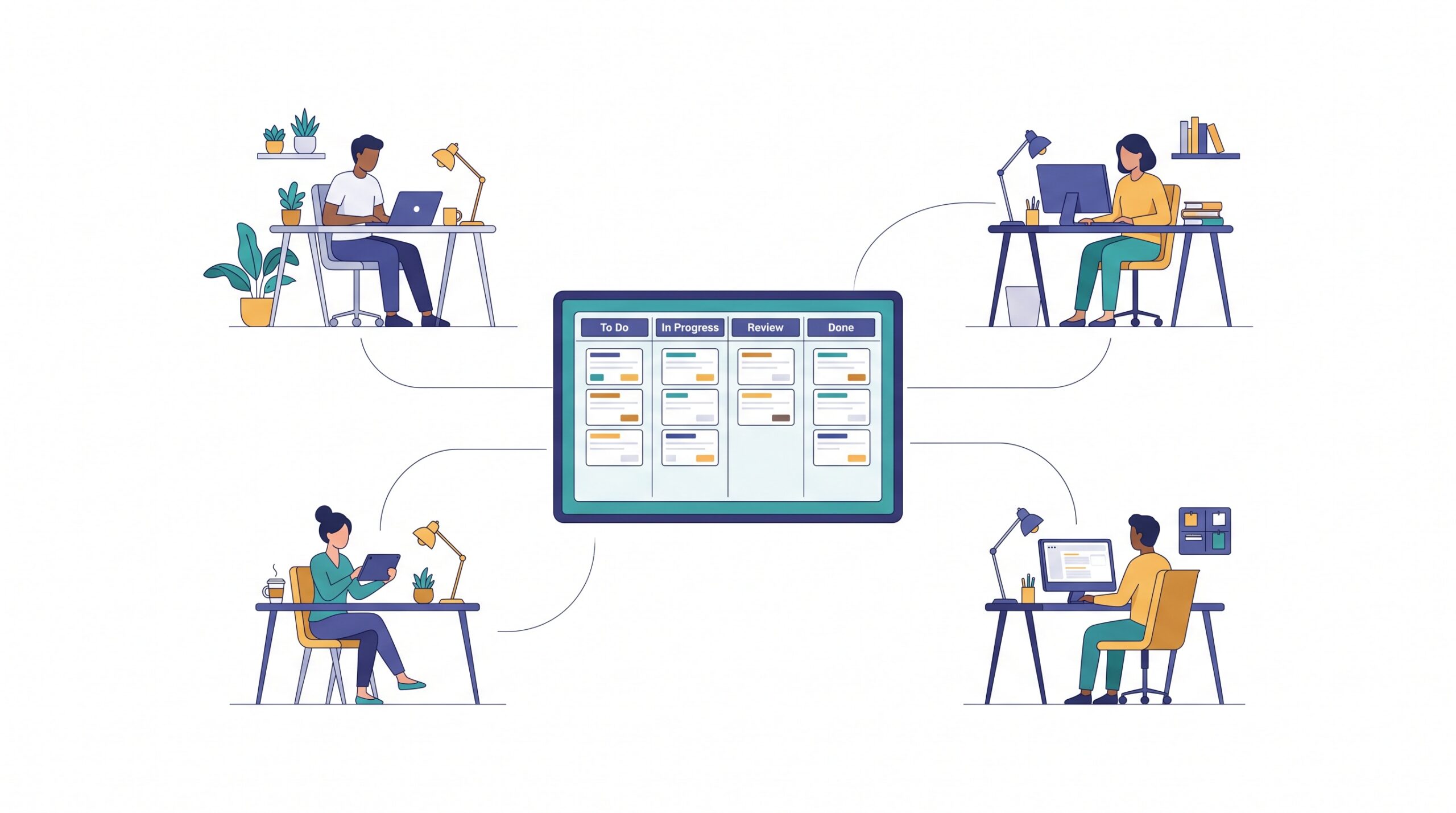
An office does one thing for a manager that is almost impossible to replace: it tells you how work is going without anyone having to say a word. You walk past a desk and see someone stuck. You overhear that a client went quiet. You notice the room is quietly heads-down before a deadline. Move that same team into separate homes and time zones and all of that ambient awareness vanishes overnight. The natural instinct is to replace it with more meetings and more check-in messages — which is exactly how remote teams end up busy, interrupted, and still in the dark. A kanban board fixes the actual problem: it becomes the shared room everyone can walk into, at any hour, and instantly see the state of the work.
What you actually lose when the team goes remote
It helps to name the thing that broke. Co-located teams run on a huge amount of invisible, informal information: who is working on what right now, what is stuck, what is nearly done, who has spare capacity, and where the mood is tense. Nobody schedules that; it leaks out of shared space. Remote work does not slow the actual tasks down — people can write code, design, or answer clients just as well from home. What it removes is the signal. Suddenly the only way to know how a project is going is to ask, and asking costs a message, an interruption, and a wait for a reply.
So the real job of a remote setup is not to recreate the office with cameras. It is to make the state of the work visible on purpose, in one place, so that knowing what is going on stops requiring a conversation.
The board is the single source of truth
This is the shift that makes remote work calm: the board, not any person’s memory or inbox, is where the truth about the work lives. If a task exists, it is a card. If it is being worked on, it is in Doing with an owner. If it is stuck, it is flagged. That rule sounds obvious, but it is the whole game — because the moment the board is authoritative, nobody has to interrupt anybody to find out where things stand. A teammate in another time zone, a manager between meetings, a client checking in: all of them can look at the same board and get the same answer.
For that to hold, everyone has to trust the board enough to keep it current. A card that says Doing but was actually finished yesterday is worse than no board at all, because it quietly teaches people to stop believing it. The habit to protect above all others on a remote team is simple: when your work changes state, move the card — before you close the laptop, not at some weekly cleanup.

Design the board for people who are never online together
A remote board has to be readable by someone who cannot tap you on the shoulder to ask what a card means. That raises the bar on clarity. A card should carry enough that the next person can act on it alone: what needs doing, who owns it, what “done” looks like, and any link or file they need. Vague cards survive in an office because you can just ask across the desk. Remote, a vague card becomes a blocked card the moment its owner logs off.
The same goes for the rules of the board itself. In person, the unwritten conventions — what counts as ready, when you move a card, who pulls next — get absorbed by osmosis. A distributed team never gets that osmosis, so the conventions have to be written down as explicit policies everyone can point to. When the rules live on the board instead of in the founder’s head, a new hire in a different country can follow them without a single onboarding call.
Handoffs across time zones: let the board do the talking
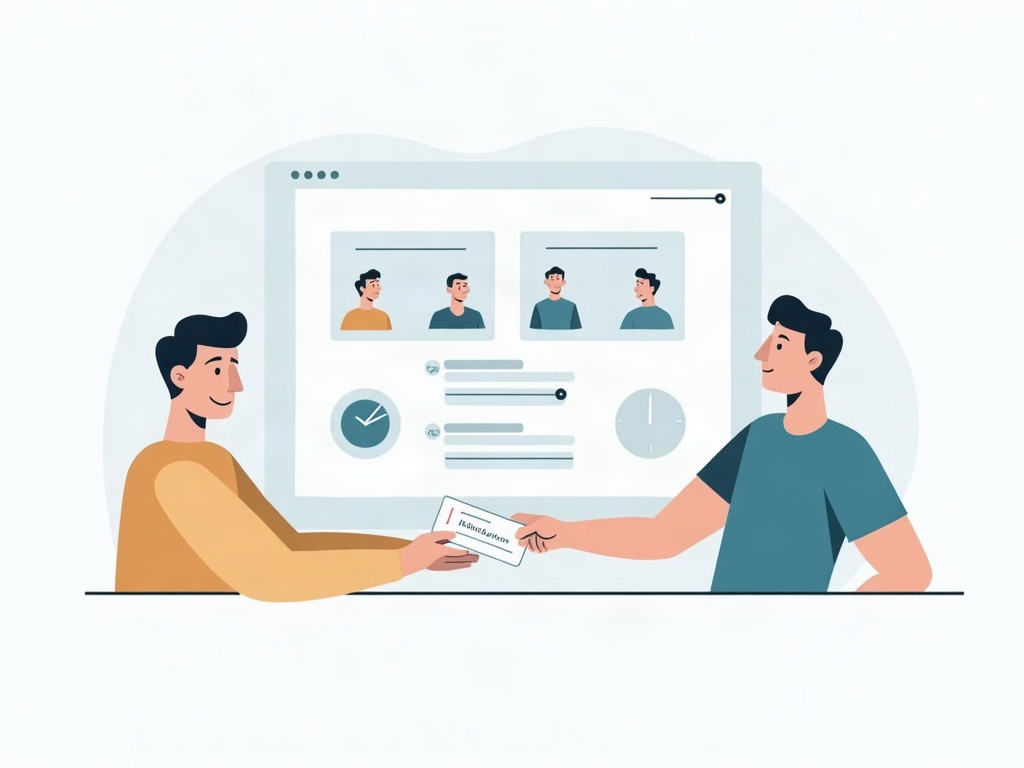
The hardest part of async, distributed work is the handoff. In an office you finish something and lean over: “this is yours now, here’s what I did.” Across time zones that conversation cannot happen live — by the time your teammate starts their day, you are asleep. The board turns that dead time into a relay. If a card is complete and well-documented when you move it, the next person picks it up cold and keeps it moving, and the work advances even while half the team is offline.
This is where an asynchronous rhythm beats a synchronous one. Rather than dragging everyone onto a call at an hour that is wrong for someone, you can lean on the pattern of replacing the daily standup with an update that lives on the board: each person notes progress and blockers on their cards, and anyone reads it whenever their day begins. A small overlap window — even an hour where most of the team is online — is worth protecting for the genuinely interactive conversations, but the routine status updates do not need it.
Oversight without surveillance
Remote management goes wrong in one predictable way: managers, missing the ambient awareness they used to have, try to buy it back with monitoring — constant check-ins, presence indicators, screenshots, “quick syncs.” It backfires, because it signals distrust and it measures the wrong thing. Being online is not the same as making progress. A board lets you swap all of that for something healthier: instead of watching whether people are busy, you watch whether work is moving.
That is a far better signal and a far lighter touch. You do not need to know that someone was at their desk from nine to five; you need to know that cards are flowing and nothing is silently stuck. This is the remote version of delegating without hovering over every task — you keep control through the visible state of the work, not through the visible presence of the person. It also puts a natural cap on overload: sensible work-in-progress limits stop a distributed team from quietly taking on more than it can finish, which is easy to miss when you cannot see the strain on anyone’s face.
Catch trouble early, when it is still small
The office’s real gift was early warning — you sensed a problem before it became a crisis. On a remote team you rebuild that by making the board loud about trouble. A card that has not moved in days, a Doing column that keeps growing, a blocker that nobody has cleared: each of those is a signal you would have felt in person and now have to see instead. Make blockers impossible to ignore and treat them as the team’s shared priority, so that a stuck card gets surfaced early rather than discovered late. A problem raised on day two is a two-minute message; the same problem found on day ten is a missed deadline and an awkward call.
The takeaway
Running a remote team is not about recreating the office — it is about replacing the one thing the office gave you for free: a shared, effortless sense of how the work is going. A kanban board does that better than any meeting can, because it is available to everyone, at every hour, in every time zone, and it never has to be scheduled. Make the board the single source of truth, write cards and rules clearly enough to be read alone, let handoffs happen on the board instead of on a call, manage the work rather than the people, and keep blockers loud. Do that and distance stops being a handicap. Your team can be scattered across the map and still, at a glance, be looking at exactly the same picture of the work.