Here’s an uncomfortable truth about kanban boards: most of the time, nobody actually looks at them. People look at their card, drag it one column to the right, and move on. The board as a whole — the full picture of what’s flowing, what’s stuck, and what’s quietly rotting in a corner — goes unexamined for days. And a board nobody steps back to read stops being a management tool and becomes just a fancier to-do list.
The fix isn’t a bigger meeting or more software. It’s a small, regular habit: once a week, spend fifteen minutes scanning the whole board on purpose. Not to update anyone, not to assign blame — just to take the board’s temperature and catch the small problems while they’re still small. Think of it as a flow health check. Here’s what it looks like and why it works.
Why the weekly scan matters more than daily updates
Day to day, you’re zoomed in. You see the one or two cards in front of you and the next thing you have to do. That’s normal and fine — it’s how work gets done. But being permanently zoomed in means you never notice the patterns: the card that’s been in “doing” for nine days, the review column slowly filling up, the three projects all waiting on the same person. Those are the things that sink a week, and none of them are visible from inside a single card.
A weekly review is the moment you deliberately zoom out. It’s also what keeps the board honest over time. Boards don’t fail all at once; they drift. Cards get out of date, columns clog, and one day people quietly stop trusting what the board says. A regular review is the single most reliable way to keep a board alive instead of abandoned, because it’s the habit that catches drift before it becomes decay.
Start with what finished
Begin the review on a positive, concrete note: look at the Done column and see what actually got completed this week. This isn’t a victory lap — it’s information. A week with plenty of finished cards and a healthy flow tells you the system is working. A week where almost nothing reached Done, despite everyone being busy, is a loud signal that work is getting stuck somewhere upstream.
Counting finished work also quietly anchors everything else. If your team reliably finishes, say, eight to ten cards a week, that number becomes a reality check for planning — and for answering the eternal “when will it be done?” question with something better than a guess. When you can see your real throughput, you stop over-promising. Once you’ve noted what landed in Done, clear it out (archive it) so the column is ready to tell next week’s story cleanly.
Hunt for stuck and stale cards
Now the most valuable part: find the cards that aren’t moving. Scan each column for anything that’s been sitting longer than it should. Some of these will be openly flagged — if you keep a visible home for blocked work, those cards are already waving their hands at you, and the review is when you actually do something about them: chase the dependency, make the call, escalate the decision.
The sneakier ones are the cards that aren’t blocked, just quietly aging. Nobody marked them stuck; they simply stopped getting attention. These are exactly the cards nobody talks about that rot on the board, and the weekly scan is how you catch them. For each one, make a decision: push it forward, hand it to someone else, shrink it, or honestly kill it. The goal isn’t to feel guilty about old cards — it’s to make sure every card on the board is either moving or gone.

Check the shape of the board
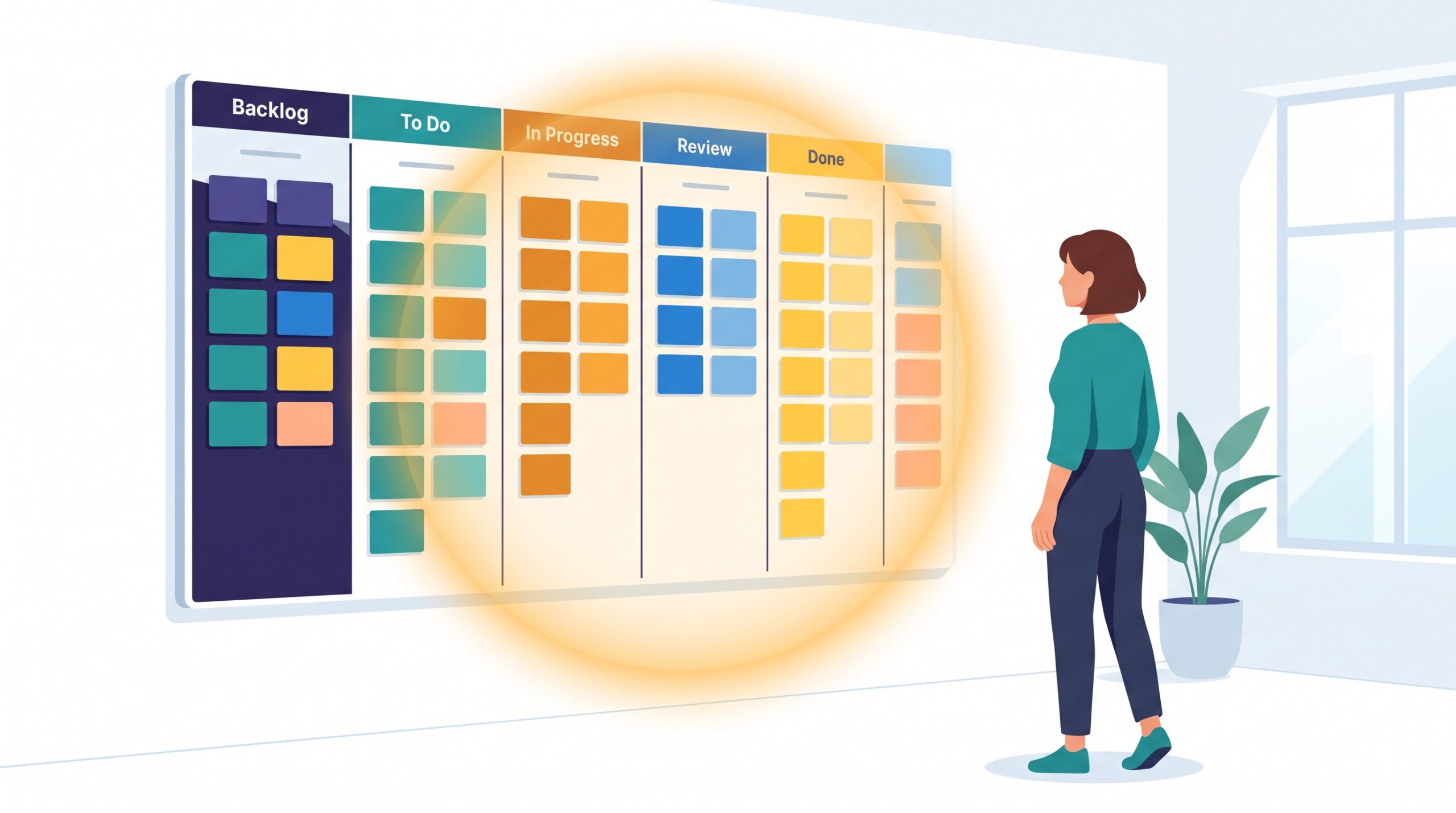
Step back once more and look at the balance across columns. Is one column badly overloaded? A “doing” column stuffed with a dozen cards means everything is half-started and nothing is finishing — the classic symptom of too much work in progress. A review column that keeps growing means approvals are the bottleneck, not the work itself. An empty “ready” column with a packed “to do” means nothing’s been teed up and the team will stall the moment they finish what they’re on.
You don’t need fancy charts to read this. The shape of the board tells you where the pressure is. When you spot a lopsided column, that’s your cue for the one or two adjustments worth making this week — tightening a limit, clearing a review backlog, or getting a few cards genuinely ready to start. Small corrections, made weekly, keep the whole system flowing.
Keep it short, and keep it shared
The review earns its keep precisely because it’s brief. Fifteen minutes is enough to scan Done, hunt the stuck cards, and read the board’s shape. The moment it swells into an hour-long status meeting where everyone recites their week, people start dreading it and it quietly dies. Protect the format: it’s a scan, not a ceremony.
If you work with a team, do it together — in front of the board, briefly, once a week. Shared eyes catch more, and the conversation about a single stuck card is often where the real problem finally gets named. If you work solo, the review is just as valuable; you’re simply being honest with yourself about what’s actually moving. Either way, pick a consistent slot — Friday afternoon or Monday morning both work — so it becomes automatic rather than something you have to remember.

How it differs from grooming the backlog
It’s worth drawing one clear line. A board review looks at work in flight — the cards already on the board, flowing (or not) toward done. That’s different from tidying up what’s coming next. If you’ve built the habit of a weekly backlog grooming session, think of these as two halves of a healthy rhythm: grooming looks forward and keeps the queue sharp, while the board review looks at the present and keeps the flow unclogged. You can run them back to back, but don’t let one swallow the other — they answer different questions.

The takeaway
A kanban board only pays you back if someone actually reads it, and “someone will glance at it eventually” is not a plan. Fifteen minutes a week — see what finished, hunt the stuck and stale cards, read the shape of the board, make one or two small corrections — is enough to keep the whole thing honest. It’s a tiny investment that quietly prevents the slow slide into a board nobody trusts. Give the review a fixed home on your calendar, keep it short, and you’ll find your board staying useful long after most teams’ boards have gone quietly dead.