If you’ve ever gone looking for a way to prioritize your backlog, you’ve probably drowned in acronyms. MoSCoW. RICE. ICE. The value/effort 2×2. WSJF, if someone in the room really wanted to show off. Each one promises to tell you what to work on next, and each one has a loud fan base. The result is that a lot of teams either adopt the fanciest-sounding method and quietly abandon it two weeks later, or throw up their hands and keep working on whatever shouted loudest this morning.
Here’s the reassuring part: you don’t need to master all of them. You need to recognize which one fits the decision in front of you. A prioritization method is just a lens for comparing cards. Different lenses answer different questions, and most small teams only ever need two or three. This is the practical guide to picking the right one — and it builds directly on the idea that your backlog should be a ranked list, not a bucket.
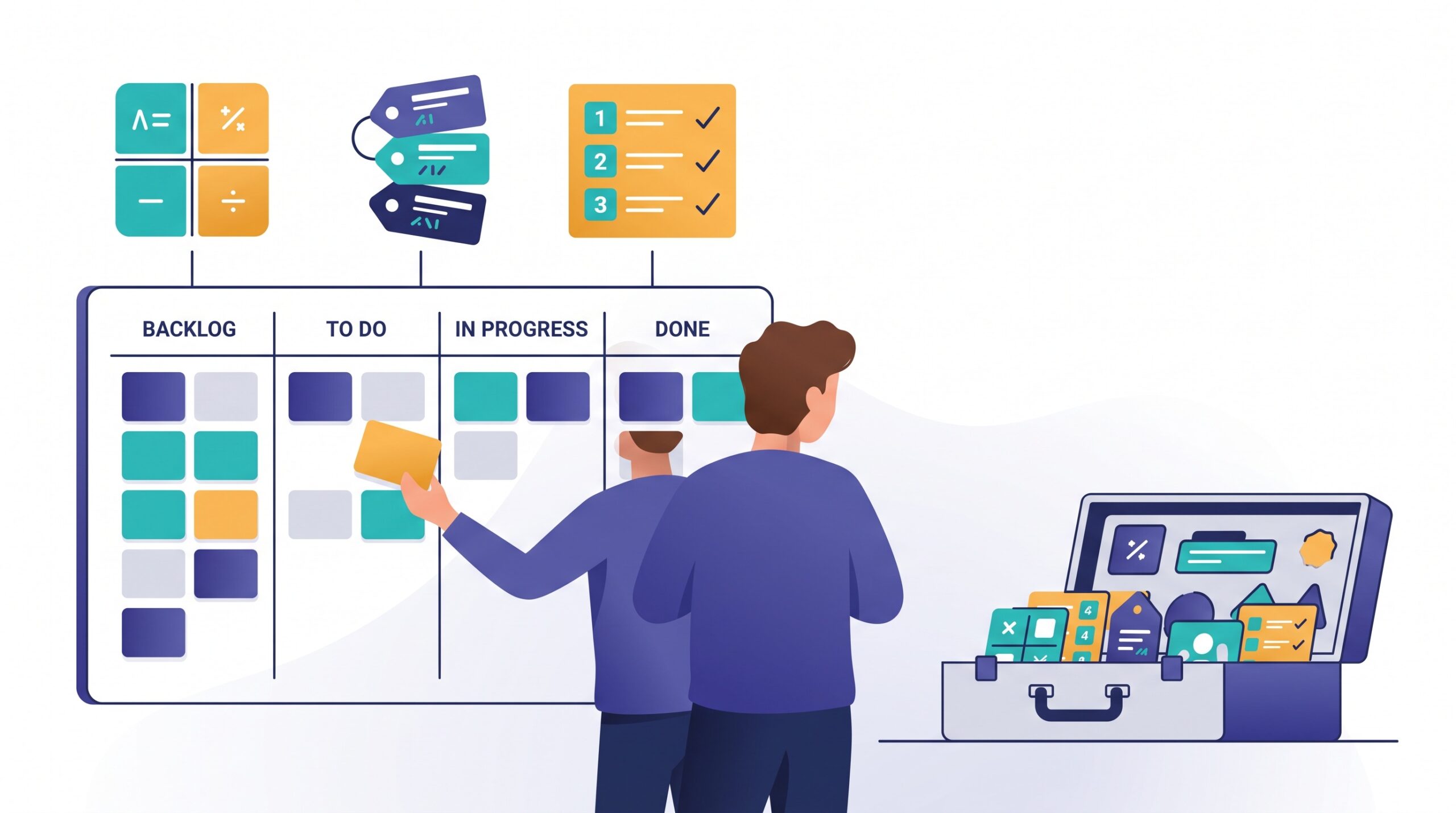
The value/effort 2×2: your everyday workhorse
If you only learn one method, make it this one. Draw two axes in your head: how much value a card delivers, and how much effort it takes. Every card lands in one of four quadrants, and the quadrants tell you almost everything.
- High value, low effort — your quick wins. Do these first, always. They’re the reason this method earns its keep.
- High value, high effort — big bets. Worth doing, but plan them deliberately rather than squeezing them in.
- Low value, low effort — fill-in work. Fine when you have a gap, never worth displacing a quick win.
- Low value, high effort — the trap. Be honest and drop these, or they’ll eat your week.

The 2×2 is fast, it needs no spreadsheet, and it exposes the cards everyone secretly knew were a bad use of time. Its weakness is that “value” and “effort” are eyeballed, so it’s great for a quick team sort and weak for high-stakes decisions where you need to show your work. For the weekly “what do we tackle next” conversation, it’s usually all you need.
MoSCoW: when everything is somehow a “must”
MoSCoW stands for Must-have, Should-have, Could-have, and Won’t-have-this-time. Instead of ranking cards one by one, you sort them into those four tiers. It shines in one specific, painful situation: when you have a fixed deadline or a fixed scope, and everyone insists their item is non-negotiable.
The discipline of MoSCoW is the cap. A “must” is defined as something without which the release, event, or launch genuinely fails — not something that would be nice. If more than about half your cards are “musts,” you haven’t prioritized; you’ve just relabeled the pile. Forcing items down into “should” and “could” is where the real conversation happens, and the “won’t — this time” bucket is a gift, because it tells people their idea isn’t rejected, just not now.

Use MoSCoW for scoped efforts with a hard edge: a product launch, an event, a client deliverable. It pairs naturally with classes of service, since a “must” on a fixed date behaves very differently from a “could” with no deadline at all.
RICE and ICE: when you need a number to defend
Sometimes a gut sort isn’t enough. A stakeholder wants to know why their pet feature is ranked below someone else’s, and “it felt higher value” won’t survive the meeting. That’s when a scoring method earns its complexity.
ICE is the lighter one: score each card from 1 to 10 on Impact, Confidence (how sure are you the impact is real), and Ease, then multiply. RICE adds Reach (how many people or cases it touches) and swaps ease for Effort, which you divide by: Reach × Impact × Confidence, divided by Effort. A bigger number means a higher rank.

The point of these isn’t false precision — the scores are still estimates. The point is that they make your reasoning visible and comparable. When two people disagree, you can see exactly which factor they’re scoring differently and argue about that instead of about the conclusion. The honest caveat: scoring takes time, and it’s overkill for a five-card week. Reserve it for genuinely contested decisions or a quarterly planning sort, not your daily flow.
A quick way to choose
You don’t pick a method once and marry it. You pick per decision:
- Sorting this week’s work fast? Use the value/effort 2×2.
- Fitting work into a fixed deadline or scope? Use MoSCoW.
- Defending a contested ranking or planning a quarter? Use RICE or ICE.
- Still arguing about one urgent card jumping the queue? That’s not a prioritization-method problem — it’s a classes-of-service problem.
The worst method is the elaborate one you abandon. If in doubt, start with the 2×2 and only reach for something heavier when a real decision demands it.
Make the ranking live on the board
Whichever method you use, the output is worthless if it stays in a spreadsheet. The order has to show up where the work actually happens: your backlog column. Rank cards top to bottom so the next card to pull is simply the one at the top. If you’re using MoSCoW, label the tiers. If you scored them, note the score on the card.
And remember that a priority order isn’t a monument. It goes stale the moment reality shifts, which is why a light, regular re-sort matters far more than a perfect one-time ranking. A quick pass during your weekly backlog grooming keeps the method honest and the top of the list trustworthy — so when someone asks “what should I do next,” the board already answers.
The takeaway
Prioritization frameworks aren’t a competition, and you don’t have to pick a winner. The value/effort 2×2 handles most of your weekly sorting. MoSCoW rescues you when a deadline collides with a pile of “musts.” RICE and ICE give you a number when a ranking has to be defended. Match the lens to the decision, put the result on the board, and re-check it on a rhythm. Do that, and “what should we work on next?” stops being an argument and starts being obvious — which, in the end, is the whole job of a well-kept board.