Think about the last task that got “started” and then quietly stalled. Odds are it did not stall because someone was lazy. It stalled because the moment they picked it up, they hit a wall: they were not sure what “done” looked like, or they needed an answer from someone who was out, or the task turned out to be three tasks wearing a trench coat. The card moved into “In Progress,” but the work could not.
This is one of the most common and least discussed reasons boards clog up. We obsess over how to finish work, but a huge amount of stalling happens at the very start – because the task was never actually ready to begin. The fix is small and almost boringly practical: a Ready column, plus a short, shared idea of what earns a spot in it.
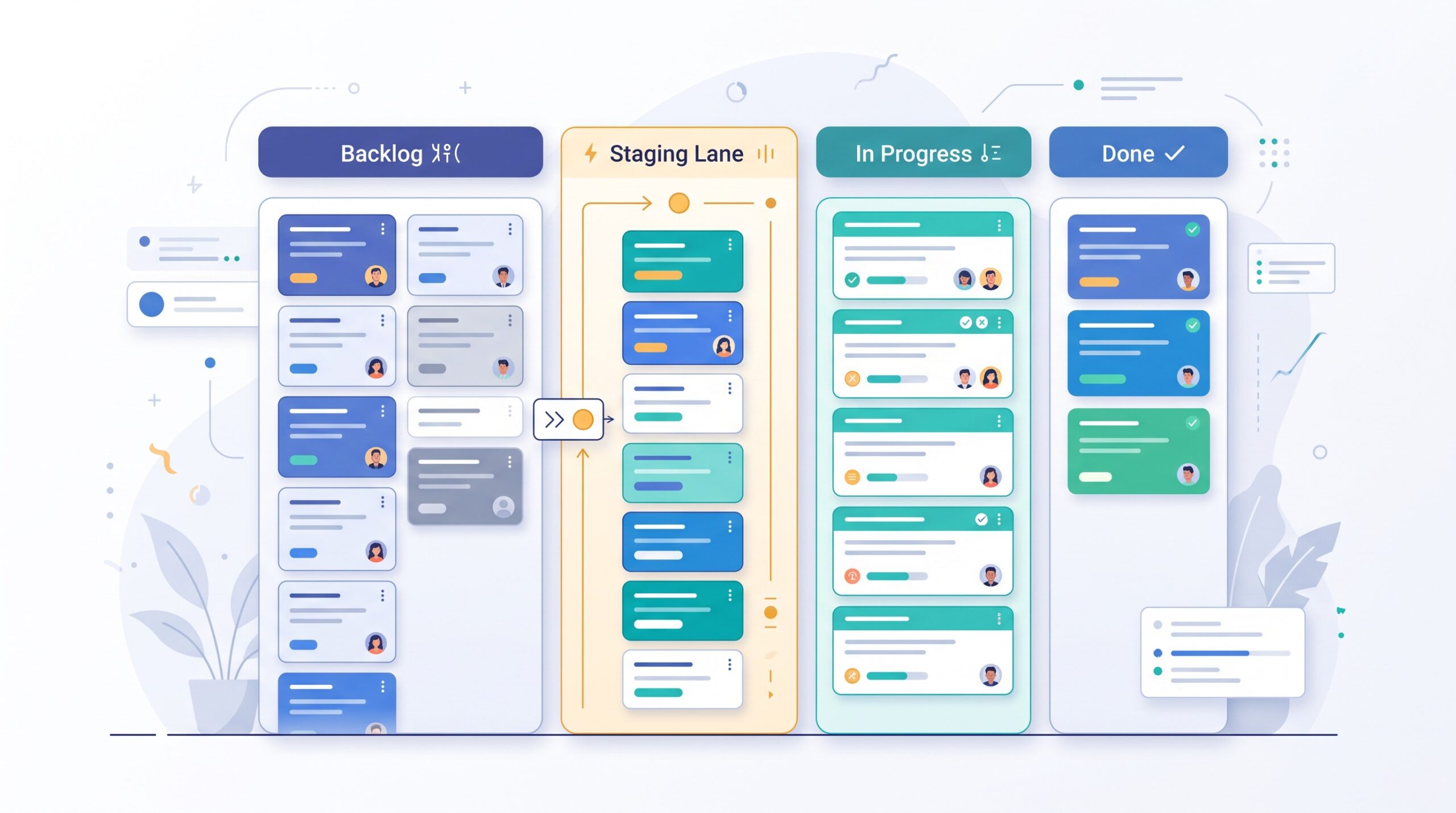
Why “start it and see” backfires
When there is no gate between your backlog and your active work, anything can be pulled into progress at any time – including things that are still half-formed. It feels productive to grab a card and dive in. But starting an unready task doesn’t create progress; it creates a stalled card that now sits in your active lane, making the board look busy while nothing actually moves.
Worse, unready work is contagious. Someone starts it, gets blocked, sets it aside, and picks up something else – which may also be unready. Before long you have several cards “in progress,” none of them moving, and a team that feels frantic but ships very little. The problem was never effort. It was that the work jumped the queue before it was fit to run.
What a Ready column actually is
A Ready column is a small holding lane that sits between your backlog (everything you might do) and your active work (what you are doing right now). Its only job is to hold tasks that are genuinely ready to be picked up – so that when anyone has capacity, they can pull the next card with confidence instead of gambling on whether it will move.
The magic is not the column itself; it is the standard you attach to it. A card only earns a place in Ready once it passes a quick check. That check is your team’s shared answer to a single question: if someone grabbed this right now, could they actually finish it without getting stuck? If yes, it is ready. If not, it stays in the backlog until it is.

A simple readiness checklist
You don’t need a heavyweight process for this. A short, honest checklist does the job. For most small teams, a card is ready when it can answer four things:
Is it clear? There is enough detail that someone other than the author could pick it up and know what success looks like. Not a novel – just a plain description and a rough idea of what “done” means.
Is it the right size? The task is small enough to finish in a reasonable chunk of time, not a disguised project. If it is enormous, it isn’t ready – it’s a card that needs breaking down first. Splitting oversized work into pieces that can actually flow is a whole discipline of its own; our guide on how to split big tasks so work actually flows walks through it.
Is it unblocked? Nothing outside your control has to happen first. No waiting on an approval, a file, or an answer from someone else. If a dependency exists, the card isn’t ready – it’s waiting.
Does it have an owner and a next step? It is clear who could take it and what the very first action is. “Look into the reporting thing” is not ready. “Draft the three columns for the weekly sales report” is.
Grooming: the habit that keeps Ready full
A Ready column is only useful if there is always something in it worth pulling. That is where a little regular grooming comes in. Once a week – or whenever the lane runs thin – spend a few minutes pulling the most important backlog items forward and sharpening them until they pass the checklist. Add the missing detail, split the giant ones, chase down the answer that would unblock them.
This is quiet, unglamorous work, and it is worth its weight in gold. Grooming a handful of cards ahead of time means that when someone finishes a task, the next one is right there, ready to go – no scramble, no “what should I even work on,” no accidentally starting something that stalls an hour later. You are doing the thinking once, calmly, instead of repeatedly under pressure.
It also fixes the handoff problem
A Ready column pays off even more when work passes between people. A lot of stalls happen precisely at handoffs, when one person finishes their part and the next person inherits something vague or incomplete. A shared readiness standard means nobody hands off a half-baked card and calls it someone else’s problem – if it isn’t ready, it doesn’t move forward. If handoffs are a recurring pain point for your team, it is worth pairing this with our take on why work stalls between people and how to fix it.
The same logic protects the people most likely to become a bottleneck. When only well-defined, unblocked work reaches an active lane, the busiest person on the team isn’t constantly interrupted to clarify fuzzy cards. That ties directly into the broader art of not being the bottleneck when you delegate work: readiness is what makes delegated tasks safe to hand off in the first place.
Start small this week
You do not need to reorganize your whole board to get the benefit. Add one column called “Ready” between your backlog and your in-progress lane. Agree on a rough checklist – clear, sized, unblocked, owned – even if it lives in a single pinned note. Then, before anyone starts something new, ask the one question: could they truly finish this without getting stuck? If not, it goes back to be groomed, not started.

Within a week or two you will notice fewer cards sitting frozen in progress, fewer mid-task scrambles for missing information, and a calmer sense that the next thing to work on is always waiting and always doable. That is the whole promise of a good board: you glance at it and simply pull the next ready card. A simple kanban board makes that gate easy to build – and once you have it, “start it and see” quietly becomes “start it and finish.”