Here’s a quick test for any team. Walk up to your board and ask two people the same question: “When exactly can a card move into the next column?” If you get two different answers – or a shrug and a “well, usually…” – you’ve found something worth fixing. Not because your team is careless, but because your board is running on rules nobody ever wrote down. Every kanban board has policies. The only question is whether they live on the wall where everyone can see them, or scattered across a few people’s memories where they quietly drift apart.
Making those rules visible is what practitioners call setting explicit policies, and it’s one of the cheapest, highest-return moves a small team can make. No new tool, no big meeting – just writing down what you already sort of agreed to. Let’s look at how to do it without turning your board into a rulebook.
The rules you never wrote down
Think about everything your board silently assumes. Which tasks are allowed onto the board at all. Who’s allowed to pull the next card. What has to be true before something counts as “in progress.” How big a card can be. What happens when work gets stuck. None of these are usually written anywhere – they’re absorbed over time, learned by watching, and enforced by whoever happens to care most that week.
That works fine until it doesn’t. A new hire joins and reinvents the rules from scratch. Two people interpret “ready” differently and half-finished work sneaks into the pipeline. Someone goes on holiday and their private convention leaves with them. Implicit rules feel efficient because they’re invisible, but invisible is exactly the problem: you can’t improve, question, or teach a rule you can’t see.

What an explicit policy actually looks like
A good policy is boring, specific, and short. It answers a real question the board keeps raising, and it fits in a sentence or two. “A card can move to In Progress only when it has an owner and a clear finish line.” “We pull the top card in the queue, not our favourite one.” “No card enters Review until its checklist is complete.” That’s it. You’re not writing a manual; you’re capturing the handful of decisions your team already makes dozens of times a day.
The magic word is explicit. An implicit policy is “we kind of try to finish things before starting new ones.” An explicit one is “the In Progress column holds three cards, maximum.” The second version can be checked at a glance, pointed at during a disagreement, and changed on purpose. Vague good intentions can’t do any of that.
Put the rules where the work happens
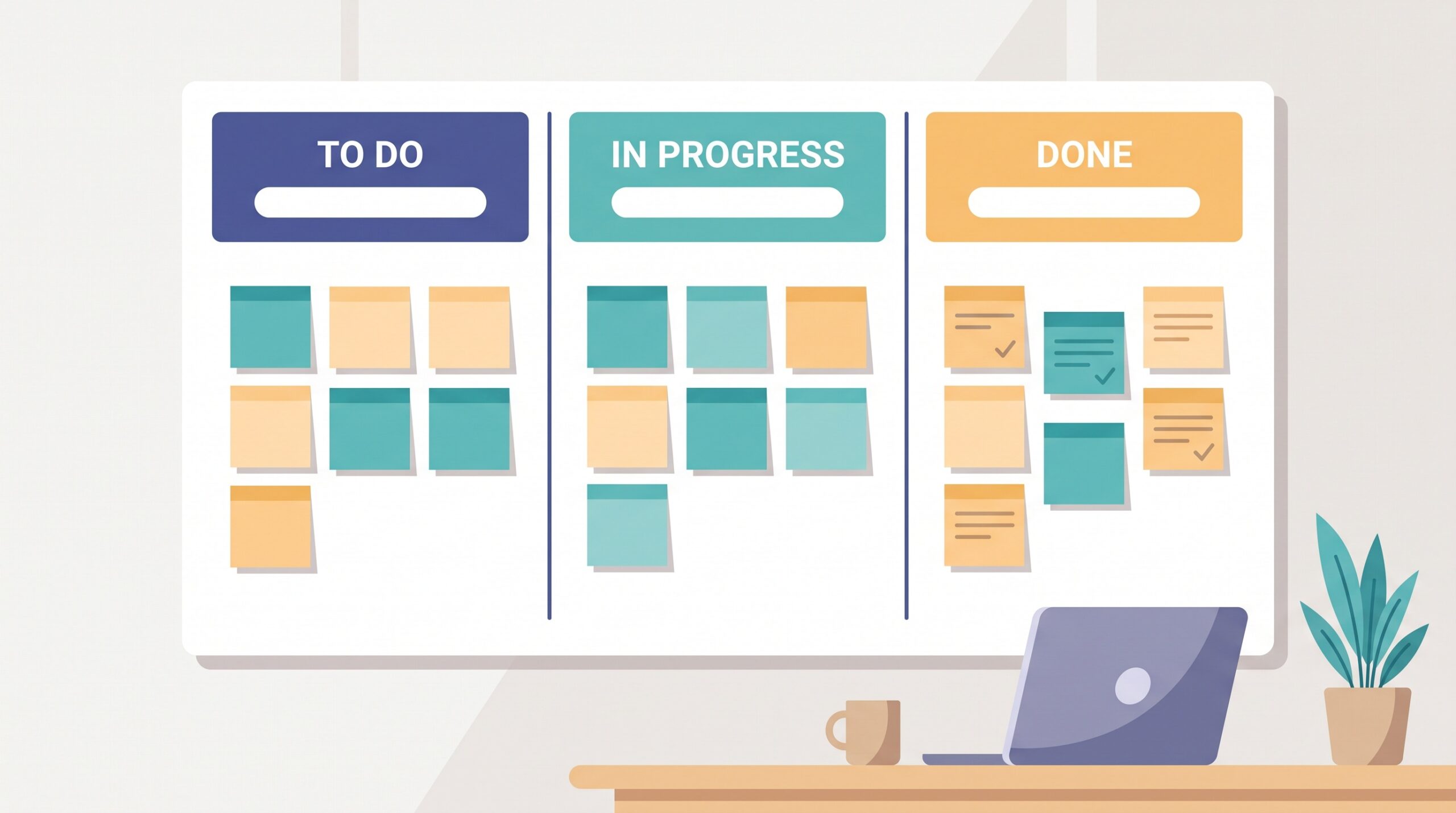
A policy nobody can find is barely better than no policy at all, so the goal is to keep the rules next to the work they govern. On a physical board, that means a small card or a strip of tape under each column header. On a digital board, it means a short note in the column description or a pinned card at the top of the list. The point is that when someone hesitates over a card, the answer is right there – not buried in a document they’ll never open.
Column headers do a lot of the heavy lifting here. Under “Ready,” write the one line that defines ready. Under “In Progress,” write the WIP limit. Under “Done,” write your finish criteria. Suddenly the board isn’t just showing you where work is – it’s showing you the rules that got it there.

The five policies worth writing first
You don’t need a policy for everything, and you shouldn’t try. Start with the five that cause the most confusion:
1. Entry criteria. What makes a card allowed onto the board? Usually an owner, a clear outcome, and a size small enough to finish in a reasonable window.
2. What “ready” means. Before work starts, what must be true – specs attached, questions answered, dependencies cleared? This one alone prevents a huge amount of stalled work.
3. How much is allowed in progress. Your work-in-progress limit per column, stated as a number, not a vibe.
4. How we pull. When you’re free, which card do you take next? Top of the queue, highest priority lane, oldest card – pick one and name it.
5. What we do with blocked work. A clear signal (a tag, a colour, a badge), a place it goes, and whose job it is to unblock it.
Keep them short, visible, and alive
The fastest way to kill explicit policies is to write too many of them. A wall of rules gets ignored just like a wall of text. Aim for a handful of one-liners, and treat anything longer as a sign the rule is too complicated to follow anyway. If you can’t say it in a sentence, your team can’t remember it in the moment.
Policies also aren’t sacred. They’re your current best guess at how work should flow, and they should change as you learn. A good habit is to glance at them during a weekly board review: is each rule still true, still helping, still being followed? If a policy is quietly ignored every day, either enforce it or delete it – a rule nobody keeps just teaches the team that rules are optional. Retiring a policy that no longer serves you is a win, not a failure.

What changes when the rules are on the wall
The payoff shows up in small, daily ways. Disagreements get shorter, because you’re pointing at a shared rule instead of debating whose memory is right. Onboarding speeds up dramatically – a new teammate can learn how your board works in a five-minute tour instead of a week of “wait, are we allowed to do that?” And the quality of your work steadies, because everyone is applying the same standard for ready, in progress, and done.
There’s a quieter benefit too. Once your rules are visible, you can finally improve them. You can look at a policy and ask whether it’s helping or just habit. You can run a small experiment – tighten a WIP limit, sharpen your definition of ready – and actually see the effect. Invisible rules can’t be tuned. Visible ones can.
So take ten minutes this week and write down the three or four rules your board already runs on. Stick them under the columns they belong to. You’re not adding process – you’re just switching on the lights over the process you already have. And if your board lives online, a simple kanban tool makes it easy to pin those rules right where the cards flow, so the next person who hesitates over a card finds the answer waiting for them.
Sources & further reading:
- The kanban way: how to visualize progress and data in Trello
- 8 Popular Project Management Tools and What They’re Useful For – Coursera